What are the acceptance rates and academic profiles at each school?
Georgetown’s overall acceptance rate was 13% for the Class of 2030 (per The Hoya, April 2026), up from 12% for the Class of 2029, the highest of the three. Northwestern’s acceptance rate sits at approximately 7%, with significant variation by school within the university (Medill is harder, Bienen is selective by audition). Vanderbilt’s overall acceptance rate is 4.6% for the Class of 2029 (2,304 admits from 50,084 applications), the lowest of the three and among the lowest of any non-Ivy private university.
| Metric | Georgetown | Northwestern | Vanderbilt |
|---|---|---|---|
| Overall Acceptance Rate | ~12% | ~7% | ~5.5-6% |
| Undergraduate Enrollment | ~7,500 | ~8,800 | ~7,150 |
| SAT Middle 50% | ~1450-1530 | ~1490-1560 | ~1500-1570 |
| Early Application Type | Restrictive Early Action | ED I and ED II | ED I and ED II |
| Need-Blind for International | No | No | No |
| Meets Full Demonstrated Need | Yes (domestic) | Yes (domestic) | Yes (all admits) |
| Standout Programs | SFS, Walsh, McDonough | Medill, McCormick, Kellogg-adjacent | Blair, Peabody, Pre-Med |
The acceptance rate differences are partly driven by application volume rather than absolute selectivity. Vanderbilt’s lower rate reflects strong applicant interest particularly from the Southeast and from students drawn by the school’s generous financial aid policy. Georgetown’s higher rate reflects in part its early application program (REA, non-binding) which produces less ED-driven yield concentration than at Northwestern or Vanderbilt. For broader context on top-25 admit rates, see our analysis comparing acceptance rates across Duke, Northwestern, and Vanderbilt.
How do the academic strengths differ across the three schools?
Georgetown’s flagship academic strengths are concentrated in international affairs and government. The Walsh School of Foreign Service is among the most prestigious undergraduate programs in international affairs in the United States, with an alumni network that dominates the State Department, the Foreign Service, and major international NGOs. Georgetown also has strong programs in pre-law (the College of Arts and Sciences feeds heavily into top-15 law schools), business (McDonough School of Business), and Catholic studies. Georgetown’s identity as a Jesuit university shapes the intellectual culture in ways that some applicants find compelling and others find alienating.
Northwestern’s flagship strengths span more disciplines. Medill is among the top three undergraduate journalism programs in the country and a primary feeder to top journalism, communications, and media careers. The McCormick School of Engineering offers strong engineering programs with the unique Whole-Brain Engineering pedagogical model. The undergraduate proximity to Kellogg School of Management (graduate-level but with undergraduate certificate programs) creates a distinctive business-adjacent academic environment. Northwestern’s School of Communication, including its theater and performance studies programs, is among the strongest in the country.
Vanderbilt’s flagship strengths include the Blair School of Music (one of the top music conservatories integrated into a top research university), Peabody College of Education and Human Development, and the College of Arts and Science with strong pre-med preparation. Vanderbilt’s medical school and academic medical center are among the top-15 nationally and provide research access for undergraduate pre-med students. Vanderbilt’s School of Engineering is solid but less distinctive nationally than McCormick at Northwestern.
Which school is best for specific intended majors?
For international affairs, foreign service, and government, Georgetown is the clear choice among the three. The combination of the Walsh School curriculum, the Washington DC location with internships at federal agencies and embassies, and the alumni network in international affairs is unmatched at Northwestern or Vanderbilt for this specific career track.
For journalism, communications, and media, Northwestern (Medill) is the clear choice. Medill’s combination of undergraduate journalism education, residency programs with major media organizations, and Chicago location creates a unique pipeline that neither Georgetown nor Vanderbilt can match for media-focused students.
For pre-med, Vanderbilt typically has the strongest combination among the three, due primarily to the Vanderbilt University Medical Center and the integrated pre-med advising. Northwestern’s pre-med program is also strong with Northwestern Memorial Hospital affiliation, and Georgetown’s pre-med program benefits from Georgetown University Medical Center, but Vanderbilt’s pre-med culture is the most concentrated and the financial aid most generous for pre-med families.
For business and finance, Northwestern’s McCormick + Kellogg-adjacent ecosystem and Vanderbilt’s strong career placement to Wall Street are roughly comparable. Georgetown’s McDonough School of Business is solid and benefits from the DC location for government-adjacent finance roles but is less competitive nationally than Wharton, Ross, Stern, or Dyson. For broader undergraduate business comparisons, see our guide to best colleges for business.
How does financial aid compare?
Vanderbilt has the most generous financial aid policy of the three. The Opportunity Vanderbilt program meets full demonstrated need without loans for all admitted students, including international students who are admitted through the school’s need-aware international admissions process. This loan-free policy makes Vanderbilt notably more affordable than peer institutions for families across the income spectrum.
Northwestern and Georgetown both meet full demonstrated need for admitted domestic students but use loans as part of typical aid packages. Both schools are need-aware for international applicants. For families above the demonstrated-need threshold, all three schools cost approximately USD 90,000 per year at full pay, with limited differences in net cost.
The financial aid differential matters most for upper-middle-class families in the USD 200,000 to USD 400,000 income band, where Vanderbilt’s loan-free policy can produce meaningfully better aid packages than Northwestern or Georgetown. Our guide on which schools negotiate financial aid provides additional context for families navigating aid decisions.
What is the location and campus culture difference?
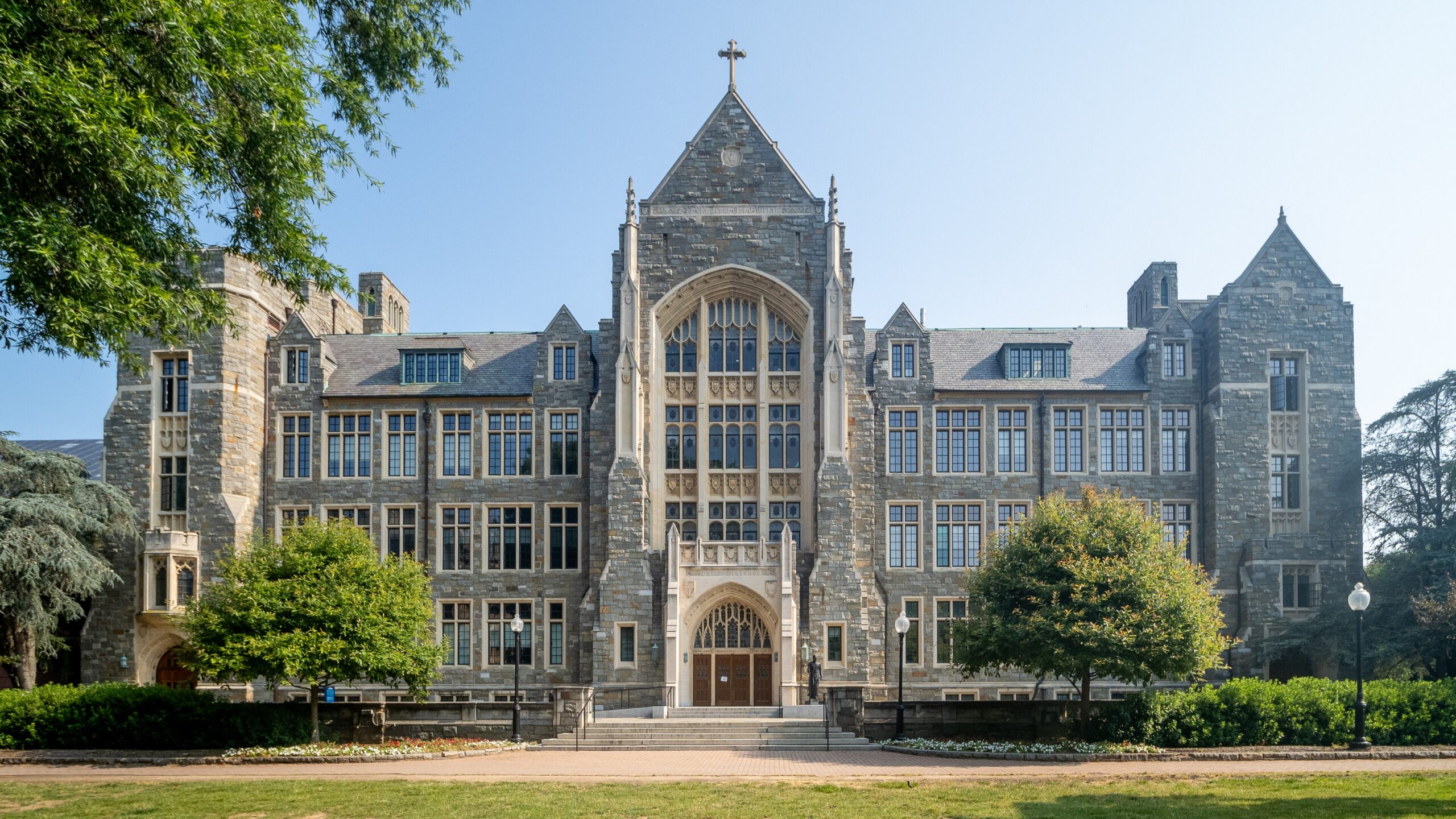
Georgetown’s location in Washington DC defines much of the undergraduate experience. The Hilltop campus sits in the Georgetown neighborhood with full integration into DC’s professional ecosystem: federal agencies, think tanks, embassies, NGOs, and political organizations all provide internship and post-graduation opportunities that students at non-DC schools do not have direct access to. The campus culture is professional, politically engaged, and somewhat conservative-leaning by elite university standards (though increasingly mixed in recent years).
Northwestern’s location in Evanston, Illinois, just north of Chicago, provides the dual advantage of a discrete college-town campus environment combined with full access to a major US city via a 30-minute commute. Northwestern’s campus culture is academically intense but socially balanced, with strong Greek life, Big Ten athletics (though basketball and football are not nationally dominant), and a generally moderate political climate.
Vanderbilt’s location in Nashville, Tennessee, has shifted substantially over the past two decades as Nashville has grown into a major Southern city with strong music industry, healthcare, and finance sectors. The campus culture remains characteristically Southern, with strong Greek life, SEC athletics, and a lifestyle balance that some applicants find appealing and others find alienating. Vanderbilt has worked to attract more diverse applicants in recent years, with notable success.
How do early application strategies differ?
Georgetown uses Restrictive Early Action, which is non-binding and prohibits simultaneous early applications to other private universities. Georgetown’s REA admit rate runs slightly higher than the RD rate but the differential is smaller than at the binding-ED schools, in the range of 12% to 14% versus 10% to 11% in RD.
Northwestern offers ED I (November 1) and ED II (January 2), both binding. ED I admit rates run approximately 20% to 25% versus 5% to 6% in RD. ED II provides a second binding option for applicants whose first-choice school did not admit them in the early round.
Vanderbilt also offers ED I and ED II. ED I admit rates run approximately 17% to 20% versus 4% to 5% in RD. The ED advantage at both Northwestern and Vanderbilt is meaningful and concentrated among unhooked applicants. For applicants whose first-choice school admitted them, the binding ED commitment is high-value; for applicants who are uncertain or who need to compare aid offers, REA at Georgetown provides more flexibility. For broader early application strategy, see our analysis of Early Decision versus Regular Decision acceptance rates.
Which school has the strongest career outcomes?
All three schools produce strong career outcomes, with median first-year compensation generally clustering between USD 75,000 and USD 110,000 for undergraduate graduates depending on major and geography. The differences are concentrated in specific career paths rather than overall quality.
For careers in foreign service, government, international affairs, and pre-law, Georgetown produces the strongest outcomes. The DC location combined with the Walsh School and McDonough alumni networks create direct pipelines into State Department, federal agencies, top-15 law schools, and international NGOs.
For careers in journalism, communications, media, and consulting, Northwestern produces the strongest outcomes. Medill graduates dominate top journalism placements, and Northwestern’s Chicago proximity creates strong pipelines into management consulting (McKinsey, BCG, Bain), corporate strategy, and media.
For careers in finance, healthcare, and Southern professional networks, Vanderbilt produces the strongest outcomes. Vanderbilt’s Wall Street pipeline is well-established, the medical school feeder is strong, and the alumni network in the Southeast is the most concentrated of the three.
How should families decide between the three?
The decision frame that produces the best outcomes is to start with intended major and geographic preference, then layer in financial aid considerations. For students with a clear first-choice major aligned with one school’s flagship strength (Georgetown for SFS, Northwestern for Medill, Vanderbilt for Blair), the choice is straightforward. For students with broader academic interests, the tiebreaker is typically location preference (Washington DC vs Chicago suburbs vs Nashville) and financial aid math.
The financial aid differential at Vanderbilt can shift the decision meaningfully in the upper-middle-income band. Families with annual incomes between USD 200,000 and USD 400,000 should run net price calculator estimates at all three schools before deciding, since Vanderbilt’s loan-free policy can produce four-year cost savings of USD 50,000 to USD 100,000 versus comparable peer institutions.
Frequently Asked Questions About Georgetown vs Northwestern vs Vanderbilt
Georgetown is in Washington, D.C., in a historic neighborhood overlooking the Potomac; Northwestern is in Evanston, Illinois, on the shore of Lake Michigan just north of Chicago; and Vanderbilt is in Nashville, Tennessee, on a parklike campus near downtown. Each setting differs sharply, from the political capital to a lakeside Chicago suburb to a vibrant Southern city, which strongly shapes the internships, culture, and lifestyle students experience.
No; none of Georgetown, Northwestern, or Vanderbilt belongs to the Ivy League, which is a specific group of eight Northeastern universities. All three are private research universities widely regarded as comparably elite and highly selective, and Vanderbilt is sometimes informally called a ‘Southern Ivy.’ Families should evaluate each on its distinctive strengths and culture rather than on whether it carries the Ivy label, since all three are prestigious in their own right.
Generally these universities consider an applicant’s best section scores across test dates, a superscoring-style approach, though each has shifted testing requirements in recent cycles between requiring scores and test-optional admission. Because policies change, applicants should confirm the current rule at each school directly. Where scores are submitted, presenting the strongest combination of section results is typically advantageous across all three institutions.
Vanderbilt is known for generous merit scholarships, including prestigious full-ride awards, in addition to strong need-based aid, while Georgetown and Northwestern focus primarily on need-based aid and meeting demonstrated need, with limited merit funding. A high-achieving applicant seeking merit money has the best odds at Vanderbilt. Families should weigh this difference, since the financial path can vary significantly depending on which of the three a student attends.
No; Early Decision is a binding commitment to attend if admitted, so a student may apply ED to only one school in a cycle. Vanderbilt and Northwestern offer binding Early Decision, while Georgetown uses a nonbinding restrictive Early Action that limits other early applications. Because early plans differ and ED is exclusive, applicants must choose a single early strategy carefully rather than applying early to multiple of the three.
Georgetown is a Catholic, Jesuit university, and that heritage shapes campus life through an emphasis on educating the whole person, service, ethics, and reflection, along with a theology requirement and active campus ministry serving many faiths. Students of all backgrounds attend and are welcomed, and religious participation is not required. Northwestern and Vanderbilt are secular by comparison, so this values-driven character distinguishes Georgetown among the three for prospective students.
Georgetown is defined by its Washington location and strength in international affairs, government, and law; Northwestern by its journalism, performing arts, and a balance of pre-professional rigor with Big Ten spirit; and Vanderbilt by its blend of Southern collegiate culture, generous merit aid, and strong programs across the arts, sciences, and education. Each offers an elite education with a distinct personality, so fit often comes down to environment and emphasis.
Vanderbilt is frequently called a ‘Southern Ivy,’ an informal label for elite Southern universities whose selectivity and prestige rival the Ivy League, though it holds no actual Ivy membership. The nickname reflects its strong academics, national reputation, and competitive admissions. Families should treat the term as a marker of prestige rather than a formal designation, evaluating Vanderbilt on its genuine strengths much as they would the other two schools.
Sources: Common Data Set; NCES College Navigator; Georgetown Office of Undergraduate Admissions; Northwestern Undergraduate Admission; Vanderbilt Office of Undergraduate Admissions; NACAC.
About Oriel Admissions
Oriel Admissions is a Princeton-based college admissions consulting firm advising families nationwide on elite university admissions strategy. Our team brings deep expertise across every dimension of the application, and our distinctive 360 approach develops strategy, positioning, activities, essays, and interviews as one coherent whole. We offer a complimentary 30-minute discovery call to discuss your family’s situation, evaluate fit, and outline next steps. Schedule your discovery call →