Hudson County College Admissions Guide: What Families at McNair Academic, High Tech, and Hoboken Should Know
By Rona Aydin
What does the Hudson County selective high school landscape actually look like?
| School | District / Location | NJ Rank (US News 2025-26) | Enrollment | Notable Strength |
|---|---|---|---|---|
| Dr. Ronald E. McNair Academic HS | Jersey City Public Schools / Jersey City | #4 NJ, #77 nationally | ~698 students 9-12 | Selective magnet, 26 AP courses, avg SAT 1280, 97% AP participation, 2018 Blue Ribbon, no class rank |
| High Tech High School | Hudson County Schools of Technology / Secaucus | #39 NJ | ~790-1,000 students 9-12 | Sciences and performing arts focus, 12:1 ratio, 350,000 sqft 2018 campus, 80-120 min daily major periods |
| County Prep High School | Hudson County Schools of Technology / Jersey City | Top 75 NJ | ~700 students 9-12 | Career and technical specialization, smaller HCST sister academy |
| Infinity Institute | Jersey City Public Schools / Jersey City | Top 50 NJ | ~440 students 6-12 | Selective 6-12 magnet, OLSAT-based middle school admission, McNair sister school |
| Saint Peter’s Prep | Independent Catholic / Jersey City | Top NJ Catholic schools | ~890 students 9-12 | Jesuit Catholic boys, established 1872, strong matriculation across Ivy and Catholic universities |
| The Hudson School | Independent / Hoboken | Top NJ private schools | ~210 students 5-12 | Small independent, intimate scale, personalized college counseling |
| Hoboken High School | Hoboken Public Schools / Hoboken | Top 200 NJ | ~700 students 9-12 | Comprehensive public, demographically diverse, IB Diploma Programme |
Each of these schools has a distinctive admissions-office identity that admissions officers at Princeton, Penn, Yale, Cornell, Columbia, NYU, and other top-30 universities recognize directly. The strategic question for Hudson County families is rarely about absolute school quality but about understanding what each school’s institutional relationships and competitive density actually mean to admissions readers. For broader NJ context, see our NJ regional college admissions guide and our NJ magnet schools guide.
Why does McNair Academic High School dominate Hudson County selective admissions?
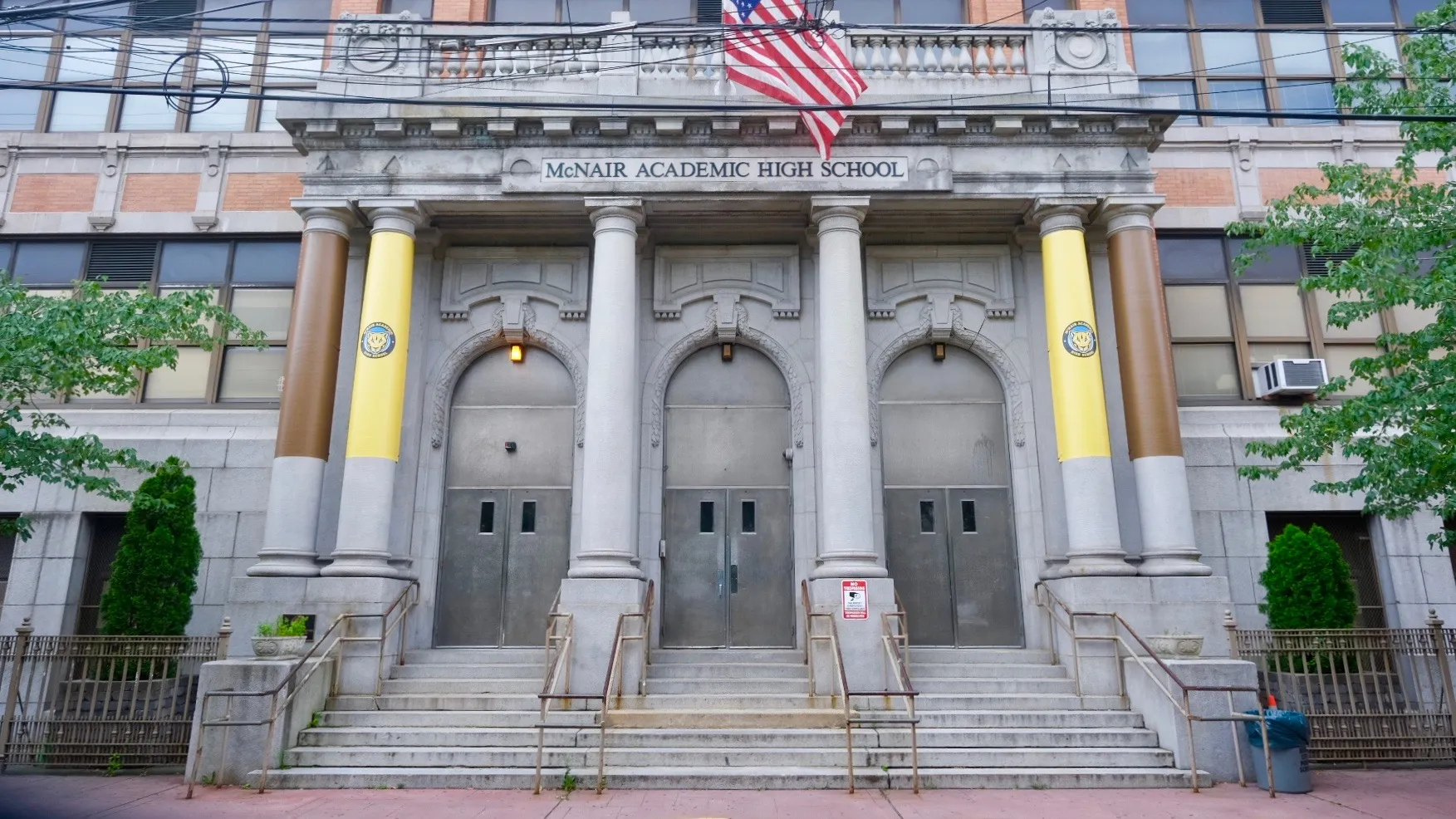
Dr. Ronald E. McNair Academic High School (named for the astronaut who died in the Space Shuttle Challenger disaster) is the strongest selective public high school in Hudson County and the #4-ranked public high school in New Jersey per US News 2025-26. The school admits approximately 240 students from approximately 1,000 applicants annually (around 24% acceptance rate), with admission based on PSAT scores, academic record, teacher recommendations, and an extensive application process. The school is open only to Jersey City residents.
The application window for entering 9th grade typically opens late November and closes in late December, with acceptance letters mailed in late January. Students respond by early February. McNair students take an average of 26 AP courses across the curriculum, with 97% AP participation. The average McNair SAT score of approximately 1280 substantively exceeds the New Jersey state average of 1070, and McNair maintains a 100% graduation rate with 100% college matriculation.
For college admissions, McNair produces strong matriculation outcomes across the Ivy League, top-30 research universities, and elite liberal arts colleges. The school’s 2018 National Blue Ribbon recognition, demographic diversity (the student population is approximately 5th most diverse public high school in NJ per Niche 2026), and rigorous curriculum produce applicants whose profiles compete credibly at Princeton, Penn, Yale, Cornell, Columbia, NYU, and the broader top-30 university landscape.
How does High Tech High School in Secaucus differ from the Lincroft school of similar name?
An important clarification: there are two distinct schools in New Jersey with similar names, and they are often confused. High Technology High School in Lincroft (Monmouth County Vocational School District) is the #1 NJ school per US News 2025-26, ranked #27 nationally and #1 STEM in America. High Tech High School in Secaucus (Hudson County Schools of Technology) is a different school, ranked #39 NJ. The two schools are not affiliated and have very different selectivity, curriculum focus, and matriculation profiles.
The Hudson County High Tech High School operates on a 22-acre campus in Secaucus (the school moved from North Bergen to a newly constructed 350,000-square-foot building in September 2018). The school enrolls approximately 790-1,000 students 9-12 with a 12:1 student-teacher ratio. The curriculum balances sciences and performing arts (the school is recognized for both fields), with juniors required to spend 80 minutes per day on their major and seniors 120 minutes per day. The school admits Hudson County residents through the HCST application process. For families interested in the higher-ranked Lincroft school, see our Monmouth County guide.
How do admissions officers actually read Hudson County applications?
Princeton, Penn, Yale, Cornell, Columbia, NYU, and other top-30 universities have NYC metro admissions officers who read Hudson County applications alongside other NYC-NJ metro applications. The implicit comparative context they bring varies substantially by school: a McNair Academic applicant is recognized as having survived selective admissions and a substantively rigorous magnet curriculum (Jersey City Public Schools’ selective option), while a High Tech HS or County Prep applicant is read as a vocational/technical specialty school applicant. Hoboken HS comprehensive public applicants are read against the comprehensive public school reference distribution. This pattern of school-specific institutional recognition is documented annually in the National Association for College Admission Counseling State of College Admission report.
The implication for Hudson County families is that McNair admission carries substantive premium with top-30 admissions readers. A McNair graduate enters the application process with a recognizable selective magnet credential that the comprehensive Hoboken HS or smaller HCST academies cannot match in name weight at most top-30 admissions offices. For comprehensive public school students, the application strategy emphasizes distinctive depth and out-of-classroom achievement that admissions officers can recognize regardless of school context.
What is the strategic value of Saint Peter’s Prep for Catholic families?
Saint Peter’s Prep (Jersey City), founded in 1872, is the strongest Catholic boys high school in Hudson County and one of the strongest Jesuit Catholic schools in the New York metro area. The school enrolls approximately 890 students 9-12 with a rigorous Catholic college preparatory curriculum, strong athletics, and strong matriculation across Catholic universities (Boston College, Georgetown, Notre Dame, Holy Cross, Fordham, Villanova) plus the broader top-30 university landscape. For Catholic families specifically, Saint Peter’s Prep offers institutional credibility at Catholic admissions offices that public school applicants typically cannot match.
The strategic comparison with McNair: Saint Peter’s Prep offers a religious education environment, all-boys peer culture, and Jesuit institutional network. McNair offers a coed magnet environment, public school cost, and slightly higher institutional name weight at non-Catholic top-30 admissions offices. The choice depends on family preference for religious education and peer environment rather than absolute admissions outcome. Top-decile students at either school compete credibly for Ivy and top-30 universities.
What test scores should Hudson County applicants target?
| School Tier Target | Competitive Floor | Strong Likely Admit |
|---|---|---|
| HYPSM (Princeton, Yale, Harvard, Stanford, MIT) | 1530 SAT / 34 ACT / 3.95 GPA | 1560+ / 35-36 / 4.00 + spike |
| Other Ivies + Top 15 (Penn, Cornell, Duke, JHU, Columbia) | 1500 SAT / 33 ACT / 3.90 GPA | 1530+ / 34-35 / 3.95+ |
| Top 16-30 (NYU, Vanderbilt, WashU, Emory, Michigan) | 1450 SAT / 32 ACT / 3.85 GPA | 1500+ / 33-34 / 3.90+ |
For benchmarking, see our Ivy League Academic Index calculator.
What are the most common Hudson County application mistakes?
Five mistakes recur. First, treating McNair admission as a guaranteed path to top-30 universities. McNair produces strong outcomes but admissions officers expect distinctive depth beyond the school credential. Second, comprehensive public school applicants assuming their grades alone will compete with McNair applicants – they will not without distinctive achievement outside the classroom. Third, confusing High Tech High School in Secaucus (HCST, ranked #39 NJ) with High Technology High School in Lincroft (MCVSD, ranked #1 NJ). The two schools are different and produce different matriculation profiles. Fourth, score-chasing past the point of marginal return. Fifth, deferring outside admissions consulting until junior year when meaningful spike development requires sophomore-year start.
For deeper analysis of why high-stat applicants get rejected, see why valedictorians get rejected from Ivies. For ED decision frameworks, see our Early Decision strategy guide. For school-specific guidance, see our HTGI cluster: Princeton, Columbia, NYU, Cornell, and Penn.
Frequently Asked Questions About Hudson County College Admissions
Yes, through context; selective colleges read every applicant against the backdrop of their school and community, so a Hudson County student is evaluated relative to the opportunities available there. A dense, urban county with strong magnet schools is understood differently from a rural area. Colleges do not admit by region, but where a student lives genuinely shapes how their record and achievements are interpreted within a holistic review.
It can cut both ways. Colleges assess students within their school’s context, so excelling at a rigorous magnet signals you thrived in a demanding environment, but intense internal competition can also make strong students look merely average by class rank. Admissions officers look at the school profile and the courses available. Performing near the top of a competitive magnet is impressive, though students should not assume the school’s name alone carries them.
Colleges value building a class from varied backgrounds, so applicants from areas that send fewer students to a given school can add diversity it seeks. This is not a guaranteed boost and never outweighs academic fit, but coming from a region underrepresented at a particular college can be a modest positive. The effect is strongest at national colleges assembling a geographically broad class rather than at in-state public universities.
Strong in-state choices include Rutgers University (New Brunswick, Newark, and Camden), the New Jersey Institute of Technology (NJIT) in Newark, Stevens Institute of Technology right in Hoboken, The College of New Jersey (TCNJ), Montclair State, and Stockton. These offer in-state value, and Stevens and NJIT are especially strong in engineering and technology. Building a balanced list that pairs reach schools with affordable in-state options is wise.
Yes; New Jersey offers state aid such as the Tuition Aid Grant (TAG) and the Garden State Guarantee for eligible residents at in-state public institutions, plus NJ STARS for high-achieving community college students. Local foundations and community organizations also offer regional awards. Because eligibility and amounts vary, families should research state programs and local scholarships early, since these can meaningfully reduce costs alongside any college-specific aid.
Often yes, as part of a balanced list; applying out of state widens opportunity, and at the wealthiest private colleges generous need-based aid can offset higher sticker prices. Out-of-state public universities, however, frequently charge high non-resident tuition with limited aid, so weigh cost carefully. A sound strategy mixes affordable New Jersey options with selective out-of-state schools chosen for fit, program strength, and realistic financial outcomes rather than prestige alone.
With attention to context; admissions officers use the school profile and known data to understand the resources and rigor an applicant experienced, recognizing both the strengths of a strong magnet and the challenges of a high-pressure or under-resourced environment. They look for students who made the most of what was available. A student who achieved strongly within their specific context can be compelling, since colleges value initiative and potential, not just polish.
Through deliberate engagement: attending virtual information sessions and local college fairs, connecting with regional admissions representatives who cover New Jersey, taking optional interviews, and writing genuinely specific ‘why us’ essays. Visiting in person helps where feasible but is not required, and colleges that track interest understand distance. Thoughtful, authentic engagement signals seriousness, which can matter at schools that consider demonstrated interest in their decisions.
About Oriel Admissions
Oriel Admissions is a Princeton-based college admissions consulting firm advising families nationwide on elite university admissions strategy. Our team includes former admissions officers from Harvard, Princeton, and Columbia. To discuss your family’s admissions strategy, schedule a consultation.