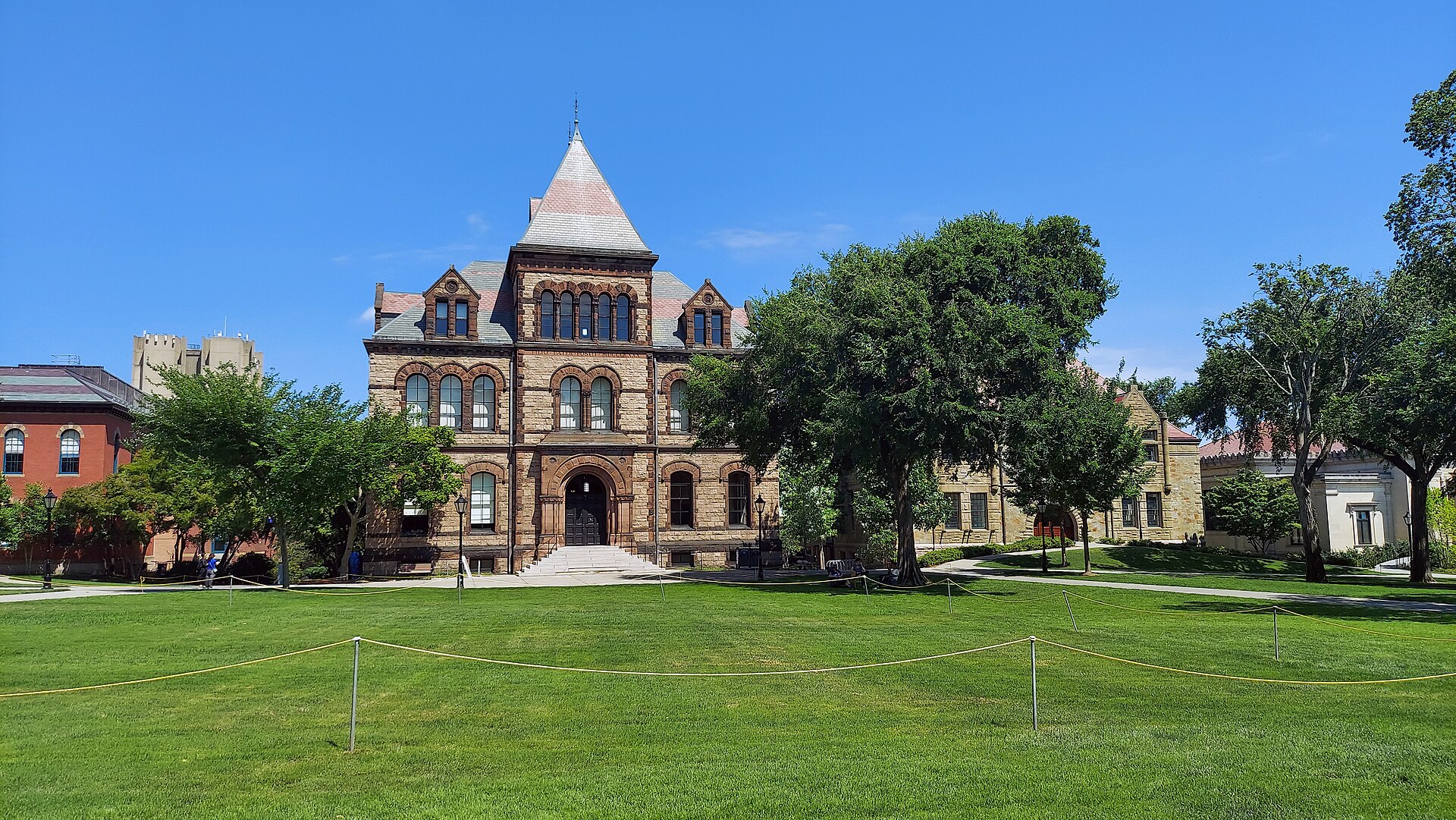
Brown University at a glance: Brown University is a private Ivy League research university in Providence, Rhode Island, founded in 1764. It is best known for its Open Curriculum, which sets no general core requirements and lets students take any course for a grade or satisfactory/no credit, along with a collaborative, student-driven culture and programs in the humanities, computer science, and the sciences. Families weighing Brown against peer schools can schedule a consultation to build a targeted college list.
Source: Brown University (www.brown.edu).
What Is Brown University Known For?
Brown is known above all for its Open Curriculum, an academic model that gives students unusual freedom to design their own course of study. Founded in 1764, it describes itself as the third college in New England and the seventh in Colonial America (Brown 250: Brown’s History), and it is a member of the Ivy League, located on College Hill in Providence, Rhode Island. Brown has no general core requirements: to earn a degree, students complete at least 30 courses, fulfill the requirements of at least one concentration, demonstrate writing competence, and enroll for the equivalent of eight full-time semesters. They may take any course for a grade or satisfactory/no credit, except courses an instructor designates as mandatory satisfactory/no credit, and the Brown grading system has no grade point averages or class rankings (Brown: Explore the Open Curriculum). This philosophy of student-directed learning, combined with a collaborative, creative culture, is central to what Brown is known for and to why it attracts independent, self-motivated students.
Brown is also known for pairing that academic freedom with genuine academic strength across the humanities, social sciences, and sciences. The university offers more than 80 undergraduate concentrations, from computer science and applied mathematics to literary arts and international and public affairs, and it is home to the Warren Alpert Medical School and the Program in Liberal Medical Education, an eight-year continuum that combines undergraduate and medical education. Brown reports a 6:1 student-to-faculty ratio, and 68% of its classes have fewer than 20 students (Brown by the Numbers). Brown admits first-year applicants, including international applicants, on a need-blind basis and meets 100% of demonstrated need without loans in its University aid packages (Brown Financial Aid: Need-Blind Admission, Brown Financial Aid). In our experience, those policies, along with an emphasis on intellectual exploration over competition, give Brown a distinctive place among the Ivy League universities.
Which Academic Programs Is Brown Best Known For?
The Open Curriculum. Brown’s signature academic model, with no general core requirements, lets students design their own course of study with the support of advisers.
Computer science and applied mathematics. Brown’s Department of Computer Science, established in 1979, describes itself as one of the nation’s leading computer science programs, and it offers concentrations in computer science, applied math and computer science, computational biology, computer science and economics, and math and computer science (Brown CS: About the Department, Brown CS: Undergraduate Program).
The humanities and literary arts. Brown says its Department of Literary Arts has been a creative and intellectual center for fifty years, and it offers courses in fiction, poetry, screenwriting, digital and cross-disciplinary writing, and translation (Brown Literary Arts). In our experience, the humanities draw students who want to explore ideas across disciplines.
Medicine and the combined program. The Program in Liberal Medical Education is an eight-year continuum that combines undergraduate study with medical education at the Warren Alpert Medical School, and Brown describes it as the only combined baccalaureate-MD program in the Ivy League (Brown Program in Liberal Medical Education).
International and public affairs. The Watson School of International and Public Affairs offers the International and Public Affairs concentration, with tracks in Development, Policy and Governance, and Security (Watson School: Undergraduate Programs).
Close faculty mentorship. Brown offers more than 900 independent study and research courses each year (Brown by the Numbers), and in our experience close relationships between undergraduates and the faculty who teach them are common.
| Category | What Brown Is Known For |
|---|---|
| Founded | 1764; Brown describes itself as the seventh college in Colonial America |
| Signature curriculum | The Open Curriculum, with no general core requirements |
| Academic strengths | Computer science, the humanities, international and public affairs, and the sciences |
| Grading option | Any course for a grade or satisfactory/no credit; no GPA or class rank |
| Financial aid | Need-blind for first-year applicants, including international applicants; meets 100% of demonstrated need without loans |
| Campus culture | Collaborative, creative, and student-directed |
| Setting | College Hill in Providence, Rhode Island |
What Is Brown Known For Beyond the Classroom?
Beyond the classroom, Brown is known for a campus culture that is creative and closely tied to the city of Providence. Its location on College Hill places students next to the Rhode Island School of Design: all Brown undergraduates may elect certain RISD courses through cross-registration, on a space-available basis and with the permission of the instructor (Brown Registrar: RISD Cross-Registration), and the Brown|RISD Dual Degree Program lets students pursue degrees at both institutions over five years (Brown|RISD Dual Degree). Brown competes in the Ivy League, and in our experience its students are known for activism, entrepreneurship, and a strong do-it-yourself spirit in clubs and projects, a reputation for independent thinking that runs through both its academics and its student life.
What Is Brown’s Campus Culture Like?
In our experience, Brown’s culture is unusually collaborative and self-directed. Because students design their own paths through the Open Curriculum, the atmosphere emphasizes intellectual exploration and personal responsibility rather than competition for grades, and the satisfactory/no credit option encourages students to take risks in unfamiliar subjects. Students we work with often describe a warm, open community where people pursue eclectic combinations of interests and support one another’s projects. The result is a campus that feels creative and independent, well suited to students who know how to make the most of freedom and who value a supportive, non-hierarchical environment over a rigidly structured one.
What Career Outcomes Is Brown Known For?
In our experience, Brown graduates go into technology, media, the arts, medicine, and public service: the computer science concentrations feed careers in software and technology, and the emphasis on writing and independent thinking prepares students for media, publishing, and the creative industries. The Program in Liberal Medical Education offers a continuous path from undergraduate study into the Warren Alpert Medical School. For families weighing the return on a selective private education, Brown’s combination of Ivy League standing, a distinctive academic model, and an active alumni community is a meaningful advantage.
What Type of Student Thrives at Brown?
Brown tends to fit students who are independent, intellectually curious, and excited by the freedom to shape their own education. Because admission is holistic and highly selective (Brown admitted 2,564 of 47,937 applicants to the Class of 2030, about 5.3%, an Oriel Admissions calculation from Brown News, March 26, 2026), strong grades and scores are expected, but the university looks closely for self-direction, creativity, and evidence that a student will use the Open Curriculum thoughtfully rather than aimlessly. Applicants who thrive at Brown often combine academic excellence with distinctive passions and a clear sense of how they learn best, and can explain why Brown’s flexible, collaborative model fits them better than a more structured or pre-professional environment. Maturity and initiative matter as much as raw achievement.
If Brown’s strengths line up with your goals, the next step is turning interest into a plan. Our college admissions timeline, along with Brown vs Dartmouth: Admissions, Curriculum, and Fit, Brown vs Cornell: Admissions, Curriculum, and Fit, and Brown supplemental essays strategy, can help you map testing, activities, and essays around a Brown-level target.
How Does Brown Compare to Its Peers?
In the experience of Oriel Admissions, families most often compare Brown with the other Ivy League universities, and what distinguishes Brown is its Open Curriculum and its collaborative, creative campus. As Brown puts it, at most universities students must complete a set of core courses, while Brown students develop a personalized course of study (Brown: The Open Curriculum). For many applicants, the decision comes down to whether they want to design their own education in a supportive, exploratory environment, or prefer the structure and requirements that many other universities provide.
Related reading: As you weigh where Brown fits among your options, see our guide on how to build a college list and use the College List Builder to sort your targets into reach, match, and safety schools.
Frequently Asked Questions About Brown
Brown is best known for its Open Curriculum, which lets students design their own course of study without general core requirements, along with a collaborative culture and programs in the humanities, computer science, and the sciences.
The Open Curriculum is the Brown academic model, and it sets no general core requirements. To graduate, students complete at least 30 courses, fulfill at least one concentration, demonstrate writing competence, and enroll for the equivalent of eight full-time semesters. They may take any course for a grade or satisfactory/no credit, and the Brown grading system has no grade point averages or class rankings.
Yes. Brown admitted 2,564 of 47,937 applicants to the Class of 2030, about 5.3% (Oriel Admissions calculation from the March 2026 Brown announcement). Admission is holistic and need-blind for first-year applicants, so strong grades and scores are expected alongside creativity, self-direction, and distinctive interests.
Brown is especially known for computer science, applied mathematics, international and public affairs, the literary arts, and the humanities, along with the eight-year Program in Liberal Medical Education, all pursued within a flexible, student-designed curriculum.
In our experience, it rewards independent, self-motivated students who use the freedom thoughtfully, but it offers less structure than a traditional core. Families should consider whether a student thrives with guidance-based, self-directed planning.
In our experience, yes. Brown graduates move into technology, media, medicine, and public service, and the computer science concentrations, the eight-year Program in Liberal Medical Education, and an active alumni network support competitive careers and graduate study.
For many families it is. Brown meets 100% of demonstrated need without loans in its University aid packages, and 51% of the Class of 2030 received need-based financial aid, so many students pay less than the sticker price. Most families with less than $60,000 in annual income have a parent responsibility of $0.
Brown stands out for its Open Curriculum, which sets no general core requirements, and, in our experience, for a collaborative, creative culture. The choice often comes down to whether a student wants to design their own education or prefers the structure and requirements that many other universities provide.
Sources: Brown by the Numbers, Brown: Explore the Open Curriculum, Brown: The Open Curriculum, Brown 250: Brown’s History, Brown Financial Aid: Need-Blind Admission, Brown Financial Aid, Brown Program in Liberal Medical Education, Brown Registrar: RISD Cross-Registration, Brown|RISD Dual Degree, Brown CS: About the Department, Brown CS: Undergraduate Program, Brown Literary Arts, Watson School: Undergraduate Programs, Brown News, March 26, 2026.
About Oriel Admissions
Oriel Admissions is a college admissions consulting firm advising families nationwide on elite university admissions strategy, with offices in Princeton, New Jersey and New York. Our strength is a deeply experienced team and a distinctive 360 approach that treats every part of the application (academics, testing, activities, essays, and interviews) as one connected strategy. To discuss your strategy, schedule a consultation.