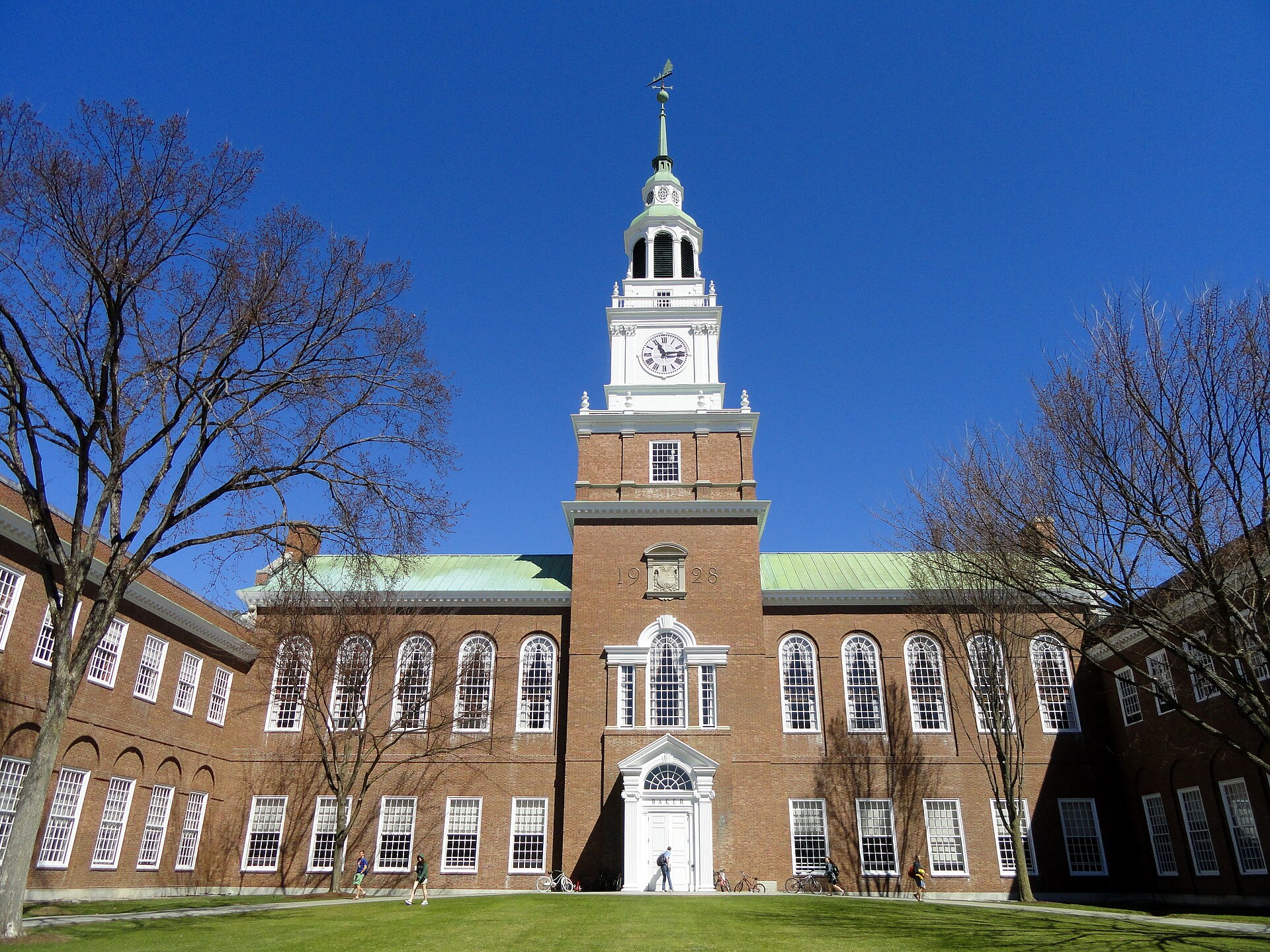
Dartmouth College at a glance: Dartmouth College is a private Ivy League research university in Hanover, New Hampshire, founded in 1769. It is best known for its strong focus on undergraduate teaching, its close-knit community in rural New Hampshire, the distinctive D-Plan academic calendar, and a loyal alumni network. Families weighing Dartmouth against peer schools can schedule a consultation to build a targeted college list.
Source: Dartmouth College (home.dartmouth.edu).
What Is Dartmouth College Known For?
Dartmouth is known for combining Ivy League standing with an intense focus on undergraduate teaching and a close, spirited community. Its charter was signed in 1769 by John Wentworth, the Royal Governor of New Hampshire, and today it enrolls more than 4,000 undergraduates in the small town of Hanover (About Dartmouth). Although it has graduate and professional schools, Dartmouth has kept the name College and continues to put undergraduates at the center of the institution, with a 7:1 undergraduate student-to-faculty ratio and most classes of 20 or fewer students. That emphasis on teaching, along with a tight-knit residential community and a striking rural setting, is a large part of what Dartmouth is known for.
Dartmouth is also known for the D-Plan, its year-round calendar of four quarters that lets students choose when they take classes and when they are on break. Every student completes one summer quarter in residence, and most choose the summer after sophomore year (Dartmouth Admissions: D-Plan). In our experience, that summer builds especially strong class bonds, and many students use leave terms for internships, research, or off-campus programs. Combined with strong programs in economics, government, engineering, and the sciences, and financial aid that is need-blind for all applicants and meets 100% of demonstrated need with no loans expected (Dartmouth Financial Aid), the D-Plan shapes a Dartmouth experience that is flexible, community-driven, and centered on undergraduates.
Which Academic Programs Is Dartmouth Best Known For?
Undergraduate teaching. Dartmouth reports a 7:1 undergraduate student-to-faculty ratio, and in our experience it is known for close mentorship and small seminars focused on undergraduates.
Economics and government. In the experience of Oriel Admissions, these are among the most popular fields at Dartmouth, feeding careers in finance, consulting, law, and public service.
The Tuck School of Business. Tuck says it was founded in 1900 as the first graduate school of management in the world (About Tuck), and its presence and alumni strengthen Dartmouth’s ties to business and finance.
Dartmouth Engineering. Dartmouth founded one of the first engineering schools in the country, and Dartmouth Engineering emphasizes hands-on problem-solving and interdisciplinary collaboration in a liberal arts setting (About Dartmouth Engineering).
The D-Plan and off-campus programs. Dartmouth’s year-round calendar gives students flexibility to study, intern, or travel, and Dartmouth offers more than 40 off-campus programs, with financial aid that travels with students (Dartmouth Financial Aid).
The outdoor and community experience. With the Dartmouth Outing Club, which Dartmouth describes as the oldest and largest collegiate outing club in the country, and a rural setting, Dartmouth is known for an outdoor culture and a close residential community.
| Category | What Dartmouth Is Known For |
|---|---|
| Founded | 1769, by a charter signed by the Royal Governor of New Hampshire |
| Academic focus | Undergraduate teaching, with a 7:1 student-to-faculty ratio |
| Signature calendar | The D-Plan, a flexible year-round, four-term schedule |
| Academic strengths | Economics, government, engineering, and the sciences |
| Financial aid | Need-blind for all applicants, meeting 100% of demonstrated need with no loans expected |
| Campus culture | Close-knit, spirited, and outdoor-oriented |
| Setting | Hanover, New Hampshire, a rural New England town |
What Is Dartmouth Known For Beyond the Classroom?
Beyond the classroom, Dartmouth is known for a vibrant outdoor culture and a deep sense of tradition. Its rural setting in New Hampshire supports the Dartmouth Outing Club, which Dartmouth describes as the oldest and largest collegiate outing club in the country (History of the DOC), and in our experience students hike, ski, and paddle throughout the year. Traditions like the Winter Carnival, Green Key, and the Homecoming bonfire on the Green are central to campus life (Dartmouth Admissions: An Introduction to Dartmouth Traditions), and Dartmouth competes in the Ivy League with strong school spirit. In our experience, the college is also known for an unusually devoted alumni network that stays involved in student life and careers.
What Is Dartmouth’s Campus Culture Like?
Dartmouth is known for a close, high-energy community that reflects its small size and remote setting. Because most students live on or near campus and share the same seasons and traditions, the college fosters strong friendships and a powerful sense of belonging, and the sophomore summer term is often described as a defining bonding experience. In our experience, social life includes an active Greek system, outdoor adventure, and school spirit, alongside serious academic work. Students describe a warm, spirited environment where people balance intense study with an active outdoor lifestyle, and the combination of a tight community and a beautiful natural setting is a large part of why alumni remain so loyal.
What Career Outcomes Is Dartmouth Known For?
Dartmouth is known for graduates who move into finance, consulting, technology, and public service. In our experience, its strength in economics and government, along with its alumni network, makes it a strong pipeline to investment banking, private equity, and management consulting, and many graduates go on to graduate and professional programs, including the Tuck School of Business and the Geisel School of Medicine at Dartmouth itself. The loyal alumni community is known, in our experience, for opening doors and mentoring younger graduates. For families weighing the return on the investment, Dartmouth’s combination of undergraduate focus, career outcomes, and its network is a significant draw.
What Type of Student Thrives at Dartmouth?
Dartmouth tends to fit students who want close contact with professors, thrive in a tight community, and are drawn to an active outdoor lifestyle and strong traditions. Because admission is holistic and highly selective, with 1,699 admits from 28,230 first-year applicants in its 2025-2026 Common Data Set, about 6.0% (Oriel Admissions calculation from the Dartmouth Common Data Set), in our experience top grades and scores are expected, but the college looks for students who will contribute to its close-knit campus and take advantage of the flexibility of the D-Plan. Applicants who do well at Dartmouth often combine academic excellence with leadership, teamwork, and a genuine enthusiasm for community and the outdoors, and can explain why a small, undergraduate-focused college in a rural setting fits them better than a large university in a city.
If Dartmouth’s strengths line up with your goals, the next step is turning interest into a plan. Our college admissions timeline, along with Columbia vs Dartmouth: Which Ivy Is the Better Fit?, Yale vs Dartmouth: Admissions, Aid, and Fit Compared, and Cornell vs Dartmouth: Which Ivy Is the Better Fit?, can help you map testing, activities, and essays around a Dartmouth-level target.
How Does Dartmouth Compare to Its Peers?
In our experience, families most often compare Dartmouth with the other Ivy League universities, though its small size and undergraduate focus set it apart. What distinguishes Dartmouth is its emphasis on teaching, its D-Plan calendar, its rural setting, and its unusually loyal alumni network. Yale and Princeton, for example, enroll 6,667 and 5,825 undergraduates (Yale Facts, Princeton Facts and Figures), compared with more than 4,000 at Dartmouth, and in our experience Penn feels more pre-professional and urban, while Dartmouth feels like a close college where undergraduates come first. For many applicants, the decision comes down to whether they want the intimacy, traditions, and outdoor culture of Dartmouth or the scale and city access of its peers.
Related reading: As you weigh where Dartmouth fits among your options, see our guide on how to build a college list and use the College List Builder to sort your targets into reach, match, and safety schools.
Frequently Asked Questions About Dartmouth
Dartmouth is best known for its strong focus on undergraduate teaching, its close-knit community in rural New Hampshire, the flexible D-Plan academic calendar, and a loyal alumni network, all within the Ivy League.
Dartmouth is an Ivy League research institution that has kept the name College, which in our experience reflects its focus on undergraduate education. It does have graduate and professional schools, including the Tuck School of Business, the Geisel School of Medicine, and Dartmouth Engineering.
The D-Plan is the year-round academic calendar of Dartmouth, which divides the year into four quarters and lets students choose when they take classes and when they are on break. Every student completes one summer quarter, and most choose the summer after sophomore year.
Yes. Dartmouth admitted 1,699 of 28,230 first-year applicants in its 2025-2026 Common Data Set, about 6.0% (Oriel Admissions calculation). Admission is holistic, so strong grades and scores are expected alongside leadership, character, and a fit with its close community.
Dartmouth is especially known for economics, government, engineering, and the sciences, along with strong programs across the liberal arts, all taught with an emphasis on undergraduates and close faculty contact.
In our experience, the small size and strong traditions of Dartmouth produce an unusually devoted alumni community that stays involved in student life and mentoring, which can open doors in finance, consulting, and other competitive fields.
In our experience, yes. Dartmouth graduates are recruited in finance, consulting, and technology, and many continue to graduate and professional programs, supported by a loyal alumni network.
For many families it is. Dartmouth is need-blind for all applicants, meets 100% of demonstrated need with no loans expected, and offers free tuition to families with total annual income under $175,000 and typical assets.
Sources: About Dartmouth, Dartmouth Admissions: D-Plan, Dartmouth Financial Aid: Introduction to Financial Aid, Dartmouth Financial Aid, Dartmouth Common Data Set 2025-2026, About Tuck, About Dartmouth Engineering, History of the DOC, Dartmouth Admissions: An Introduction to Dartmouth Traditions, Yale Facts, Princeton Facts and Figures.
About Oriel Admissions
Oriel Admissions is a college admissions consulting firm advising families nationwide on elite university admissions strategy, with offices in Princeton, New Jersey and New York. Our strength is a deeply experienced team and a distinctive 360 approach that treats every part of the application (academics, testing, activities, essays, and interviews) as one connected strategy. To discuss your strategy, schedule a consultation.