How to Get Into The Taft School: Acceptance Rate, College Matriculation, and Admission Strategy
By Rona Aydin
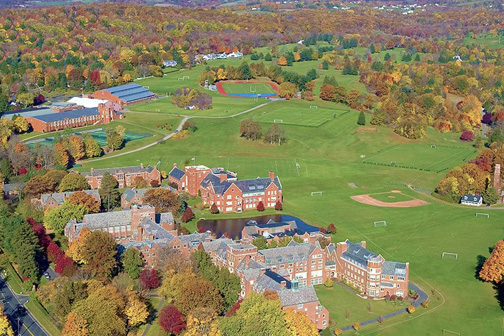
TL;DR: The Taft School’s acceptance rate is approximately 16-19% (Taft Office of Admission; institutional reporting 2024-25), placing it among the most selective independent boarding schools in the United States. Founded in 1890 by Horace Dutton Taft (brother of U.S. President William Howard Taft), the school is located on a 226-acre campus in Watertown, Connecticut, 95 miles from New York City and 125 miles from Boston. Taft enrolls approximately 600-609 students across grades 9-12 plus a postgraduate year, with 82% boarding. Boarding tuition for 2024-25 was $75,250 and day tuition was $55,500. The school motto, “Non ut sibi ministretur sed ut ministret” (“Not to be served but to serve”), permeates Taft community life. Approximately 12.47% of recent graduates matriculate to Harvard, Yale, Princeton, Stanford, and MIT combined. For families navigating Taft admission strategy or planning college applications during the Taft years, schedule a consultation with Oriel Admissions.
What is The Taft School’s acceptance rate?
The Taft School’s acceptance rate is approximately 16-19% in recent cycles (Taft Office of Admission; institutional reporting via boarding school admissions aggregators 2024-25). Taft admits approximately 175-200 new students per year, with an applicant pool that has grown substantially over the past decade. In 2023, the school’s admission rate was 16%; aggregators report rates ranging from 16% to 19% depending on cycle and grade-level entry point. The 2023 academic year saw 82% of the student body living on campus.
Strong applicants present academic profiles in the top 5-10% of their middle school class, standardized test scores at or above the 85th-90th percentile on the SSAT, two to three teacher recommendations, a student essay, parent statement, and admission interview. Taft’s applicant pool reflects national and international reach: in 2023, 45% of students identified as people of color, 18% came from abroad, and 55% had previously attended public schools. The school is a member of the Ten Schools Admission Organization and competes athletically in the Founders League.
Where do Taft graduates matriculate to college?
Taft’s college matriculation outcomes rank among the strongest at any US secondary school. Based on the most recent matriculation data, approximately 12.47% of Taft graduates matriculate to Harvard, Yale, Princeton, Stanford, or MIT combined, 16.12% to top-25 US universities, and 18.12% to top-50 US universities. Over the past five years (2020-2024), Taft students have enrolled at 191 different colleges and universities in 39 states, the District of Columbia, and six foreign countries.
Notable Taft alumni include filmmaker Peter Berg (Friday Night Lights, Lone Survivor), Grammy Award-winning singer-songwriter Mary Chapin Carpenter, and Blumhouse Productions founder/CEO Jason Blum. The school’s deep connection to American political history runs through its founder Horace Taft, brother of President William Howard Taft and uncle of Senator Robert A. Taft. Average Taft SAT in recent reporting is 1370 and ACT is 30. For broader context on elite US universities’ acceptance rates, see our Ivy League acceptance rates analysis.
| Matriculation Tier | Approx. Share of Class | Representative Schools |
|---|---|---|
| Harvard, Yale, Princeton, Stanford, MIT (HYPSM) | ~12.47% | Harvard, Yale, Princeton, Stanford, MIT |
| Top-25 US Universities | ~16.12% | Penn, Brown, Cornell, Dartmouth, Columbia, Duke, Northwestern, Johns Hopkins, Caltech |
| Top-50 US Universities | ~18.12% | Vanderbilt, Rice, Carnegie Mellon, WashU, Notre Dame, UVA, UCLA, UC Berkeley, Michigan, UNC |
| Elite Liberal Arts Colleges | Substantial | Williams, Amherst, Pomona, Swarthmore, Bowdoin, Middlebury, Wellesley |
Source: Taft College Counseling Office published matriculation data; institutional reporting via boarding school admissions aggregators 2024-25.
What does it cost to attend The Taft School?
The Taft School’s tuition for the 2024-25 academic year was $75,250 for boarding students and $55,500 for day students (Taft Business Office published rates). Taft notes that its tuition does not cover the full cost of a Taft education; the difference is made up through endowment funds and gifts. Additional costs include textbooks, personal expenses, optional programs, athletic equipment, and senior-year college application costs. Total cost of attendance for boarding students approaches $78,000-$80,000 per year before financial aid.
Taft operates a robust need-based financial aid program with an $11 million annual financial aid budget and nearly 225 named and endowed scholarships. Approximately 35-36% of Taft students receive financial aid. The school commits to meeting 100% of demonstrated financial need for admitted families. Taft’s endowment stood at $299.6 million as of June 30, 2023. Some endowed gifts date back to founder Horace Taft’s era. Families with household incomes under approximately $100,000 typically receive substantial aid; partial aid extends to families significantly above that threshold based on demonstrated need.
What makes Taft distinctive among elite boarding schools?
Three institutional features distinguish The Taft School from peer boarding schools. First, the school’s motto and service ethos: “Non ut sibi ministretur sed ut ministret” (“Not to be served but to serve”) permeates every aspect of Taft community life. The motto reflects the founding vision of Horace Dutton Taft, who in 1890 established the school on principles of moral responsibility and academic excellence. Taft’s commitment to community service is structurally embedded in the curriculum and co-curricular programming.
Second, the 226-acre Watertown, Connecticut campus, which Architectural Digest named the most beautiful private high school campus in Connecticut in 2018. The historic buildings (the school owns several homes within the Watertown Center Historic District, listed on the National Register of Historic Places) combine with state-of-the-art athletic facilities: an 18-hole golf course, 16 tennis courts (four indoor), eight squash courts, two field houses, two tracks, two ice hockey rinks, and more than 10 playing fields. Third, the Hotchkiss-Taft athletic rivalry, one of the most established in the Founders League and New England prep school athletics. For families weighing the broader value of elite educational pathways, see our ROI analysis on elite education.
When and how should families apply to Taft?
The Taft application timeline runs on a defined annual cycle. The application deadline is January 15 for entry in September that year. Taft accepts the Gateway to Prep School Application (recommended) or the Standard Application Online (SAO). Required materials include school transcripts from the current and prior two academic years, SSAT standardized test scores (TOEFL accepted for international students), two to three teacher recommendations, a student essay, parent statement, and admission interview.
Interviews can be conducted on campus, virtually, or with Taft representatives in major metropolitan areas. On-campus interviews are strongly preferred and pair with a campus tour through the 226-acre property. Decisions are typically released on March 10. Most Taft applicants are also applying to Phillips Exeter, Phillips Andover, Choate, Deerfield, Hotchkiss, and Lawrenceville; the strategic baseline is to apply to 4-8 boarding schools across selectivity tiers. Taft’s holistic review emphasizes academic records, essays, extracurricular achievements, leadership potential, and recommendations – with particular weight on demonstrated commitment to service and leadership.
How does Taft compare to other Ten Schools peers?
Taft (600-609 students) is comparable in size to Hotchkiss (600-630), smaller than Phillips Exeter, Phillips Andover, Lawrenceville, and Choate (each 800+), and larger than Hill (527-539) and St. Paul’s (542). The 16-19% acceptance rate is competitive with peer Ten Schools members. Tuition at $75,250 boarding sits above Phillips Exeter ($69,537), Choate ($69,370), Hotchkiss ($71,170), and St. Paul’s ($71,800), comparable to Loomis Chaffee (~$74,000), and below Phillips Andover ($76,731) and Hill ($78,300).
Taft’s most distinctive comparative position among Ten Schools peers is its service-oriented institutional culture, anchored in the “Not to be served but to serve” motto. The athletic facilities (18-hole golf course, 16 tennis courts, two Olympic-sized ice hockey rinks) are among the most extensive in the Ten Schools peer set. Geographic positioning: Watertown, Connecticut, is in Litchfield County, accessible from New York (95 miles, approximately 2 hours) and Boston (125 miles, approximately 2.5 hours). The Founders League athletic rivalry with Hotchkiss is institutionally distinctive.
How does Taft prepare students for elite college admissions?
Taft’s College Counseling Office maintains established relationships with admissions offices at virtually every selective US university. Each senior is assigned a college counselor in junior year who works closely with the family through the application process. Taft students benefit from 200+ courses including Advanced Placement (AP) and post-AP options in STEM, humanities, and arts, plus Signature Programs including Global Studies and Service that integrate academics with global awareness and civic engagement. The 5:1 student-faculty ratio supports close mentorship.
Selective university admissions officers read Taft applications in the context of historical Taft cohorts. Students who pursue the most rigorous coursework, engage substantively with the residential community and service programs, and develop strong relationships with faculty for recommendation letters tend to compete strongly. The Class of 2023’s strong matriculation outcomes (12.47% HYPSM rate) reflect the institutional preparation Taft provides. For families seeking additional strategic support that complements the school’s College Counseling Office, independent advising from Oriel Admissions can supplement what Taft provides. For school-list construction principles, see our reach, match, and safety school guide.
What does the day student experience at Taft look like?
Taft enrolls a meaningful day-student population (approximately 18% of total enrollment), primarily from the Watertown, Litchfield, Waterbury, and broader Litchfield County region of Connecticut, with some commuting from the New York/Connecticut border areas. Day students participate fully in academic and co-curricular life and have access to athletics, arts, clubs, and the school’s Signature Programs. Day tuition at $55,500 saves approximately $20,000 per year versus boarding.
The trade-off for day students is reduced immersion in the residential community that defines much of the Taft experience. Dorm life, seated meals in the LEED Gold-certified dining hall (opened 2010), evening dining hall conversations, weekend campus activity, and Founders League athletic events are central to how Taft builds peer and faculty relationships. The strongest day-student outcomes typically involve active engagement with weekend programming, athletics, club leadership, service initiatives, and frequent campus presence outside required class time.
Frequently Asked Questions About The Taft School
Yes; Taft is a coeducational boarding and day school, enrolling both boys and girls across its grades, unlike single-sex preparatory schools. This shapes a balanced campus community. Families considering Taft should know it offers a coed residential environment, which many find reflects the dynamic of a typical college campus, and the coeducational setting is part of the everyday social and academic experience for boarding and day students alike at the school.
Taft is nonsectarian, meaning it has no formal religious affiliation and welcomes students of all faiths and backgrounds rather than being tied to a particular denomination. Its focus is academic and character-driven. Families should expect a secular environment that respects diverse beliefs, so a student’s religious background is not a factor in admission, and the school’s traditions center on its educational mission rather than any specific religious practice or requirement.
Like many boarding schools, Taft sets expectations around phone and device use to support focus, community, and academic life, with specific rules that can evolve over time. Policies often limit use during classes, study hours, and certain communal times. Families should review the current student handbook or ask admissions directly, since device guidelines are designed to balance connectivity with the residential community’s emphasis on engagement, study, and in-person interaction among students.
Yes; like its peer preparatory schools, Taft includes world language study as part of its academic program, expecting students to reach a level of proficiency as part of graduation. Multiple languages are typically offered. Families should confirm the specific requirement and available languages with the school, since strong language preparation is a standard component of an elite boarding school curriculum and supports the college-preparatory rigor Taft is known for among its peers.
Yes; like many elite boarding schools, Taft emphasizes integrity and character through community expectations and an honor-based culture governing academic honesty and personal conduct. This reflects the school’s focus on values alongside academics. Families should understand that such expectations are central to boarding school life, holding students to high standards of honesty and responsibility, and the culture of integrity is part of what defines the residential experience and community at Taft.
Yes; like many traditional preparatory schools, Taft maintains a dress code setting expectations for appropriate attire during the academic day, though it is typically a code rather than a single uniform. Standards can vary by occasion. Families should review the current dress expectations with the school, since the policy reflects the formal, community-oriented culture common at elite boarding schools and is part of the daily rhythm students follow on campus.
Taft serves students in the upper school grades, typically ninth through twelfth, and also enrolls postgraduate students for an additional year before college. It does not serve younger elementary grades. Families considering Taft should confirm entry points, since most students apply for ninth or tenth grade, and the postgraduate year offers an additional option for students seeking another year of preparation before beginning their college careers at the school.
Graduation requires completing a college-preparatory program spanning core disciplines such as English, mathematics, science, history, and world languages, along with arts and athletic commitments typical of elite boarding schools. Specific credit counts apply. Families should review the current requirements with the school, since the rigorous distribution is designed to prepare students thoroughly for selective college admission and reflects the demanding academic standards Taft maintains across its curriculum.
Sources: The Taft School Office of Admission; Taft Affording Taft (Financial Aid); Wikipedia institutional history; Boarding School Review profile; National Center for Education Statistics; Gateway to Prep School Application.
About Oriel Admissions
Oriel Admissions is a Princeton-based college admissions consulting firm advising families nationwide on elite university admissions strategy. Our team brings deep expertise across every dimension of the application, and our distinctive 360 approach develops strategy, positioning, activities, essays, and interviews as one coherent whole. To discuss your family’s admissions strategy, schedule a consultation.