How to Get Into The Spence School: Admissions Strategy for NYC’s Elite All-Girls School
By Rona Aydin
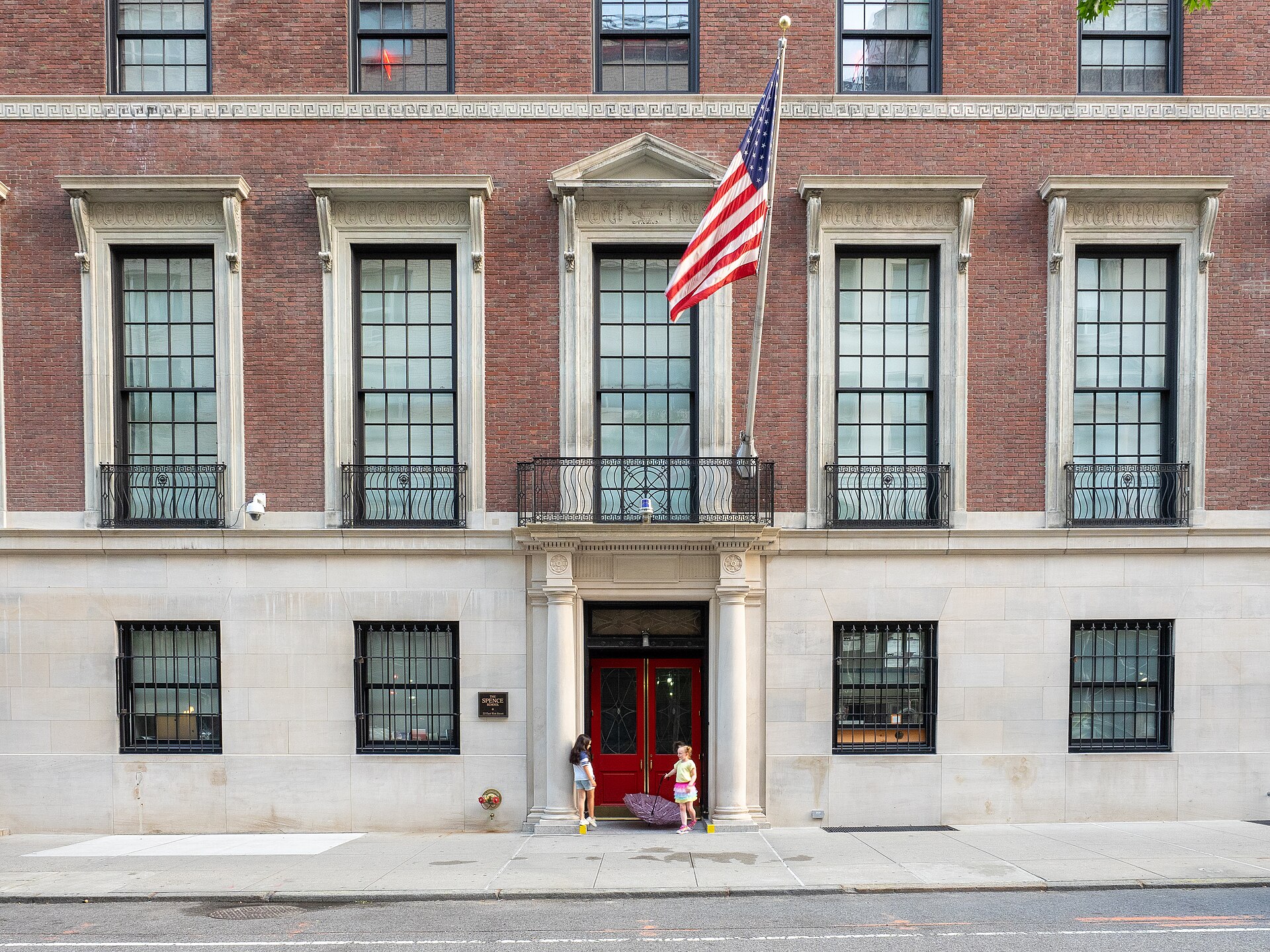
What is The Spence School and why is it a top all-girls school?
The Spence School is a K-12 all-girls independent day school founded in 1892 by Clara B. Spence and located on Manhattan’s Upper East Side. The school enrolls approximately 740 students across grades K-12. Lower School (K-4) average class size is 16-18; Middle and Upper School (Grades 5-12) average class size is 13-14. The student-faculty ratio is 7:1, and students of color in all grades make up approximately 33% of the student body.
| The Spence School at a Glance | Detail |
|---|---|
| Type | All-girls K-12 independent day school |
| Founded | 1892 by Clara B. Spence |
| Location | Manhattan, Upper East Side |
| Enrollment | ~740 students across K-12 |
| Student-faculty ratio | 7:1 |
| Class sizes | Lower (K-4) 16-18; Middle/Upper (5-12) 13-14 |
| Acceptance rate (estimate) | ~10-15% at Kindergarten and Grade 9 entry points |
| Primary entry points | Kindergarten and Grade 9 |
| Tuition (2025-2026) | $68,480 (fully inclusive) |
| Financial aid | One in five students receive aid (~$8.1M annual budget) |
| Affiliations | NY Interschool (with Brearley, Chapin, Collegiate) |
| Recognition | Forbes “America’s Best Prep Schools”; Niche #1 or #2 NYC for college matriculation |
Spence is formally affiliated with the Brearley School, the Chapin School, and the all-boys Collegiate School through the New York Interschool consortium. The school’s motto, “Not for school but for life we learn,” shapes Spence’s emphasis on developing girls and young women for academic excellence and responsible citizenship. Forbes magazine has ranked Spence among its “America’s Best Prep Schools” list.
What is Spence’s acceptance rate?
Spence does not publish an official acceptance rate. The school is widely considered one of the three most selective all-girls K-12 day schools in NYC alongside Brearley and Chapin. Independent admissions analyst estimates place Spence’s acceptance rate near 10-15% at the Kindergarten and Grade 9 entry points. The school enrolls approximately 760-810 students across recent years; class sizes are highest at Kindergarten and Grade 9, with smaller cohorts entering through attrition at other grades.
Non-entry grades (Grades 1-4, 5-8 outside Middle School entry points, 10-11) admit only when current students leave the school, which is uncommon. Families should apply but maintain realistic expectations and parallel applications to peer NYC schools.
How does Spence’s admissions process work?
Spence follows ISAAGNY’s coordinated calendar for the admissions cycle. The application opens in early September on the Ravenna platform. The application deadline for Kindergarten and Grade 9 is December 1. A complete Spence application includes the online application form, parent statement, student essay (Grade 5 and up), teacher recommendations (current English and Math teachers plus counselor or principal), transcripts for the current and prior year, ISEE or SSAT scores (Grade 5 and up), and the required in-person interview and tour.
Spence’s student interview is conducted in person and evaluates intellectual curiosity, conversational depth, and developmental fit with the school’s rigorous all-girls environment. For Kindergarten applicants, the school conducts a child visit during which trained faculty observe social interaction, language development, and self-regulation. Apply early in the cycle to secure interview appointments; Spence has a limited number of interview slots and gives some priority to families who apply earlier in the season.
What does Spence cost in 2025-26 and what financial aid is available?
Spence’s tuition for the 2025-2026 academic year is $68,480 for all grades K-12 (Spence School Office of Admission). The tuition is inclusive of all program costs including books, class trips, and meal services. Three nominal fees apply: $50 Parents’ Association dues per family, $75 class dues per child, and $75 registration fee. Spence offers three payment plan choices: annual, semi-annual, or monthly across eight months.
Approximately one in five Spence students (20%) receive need-based financial aid. The school allocates $8.1 million annually to need-based aid to make Spence accessible to a range of families. All financial aid is determined through the Clarity Application. The financial aid application deadline was December 1, 2025 for the 2026-2027 academic year. Spence does not offer merit-based aid.
What ISEE or SSAT scores does Spence expect?
Spence accepts both the ISEE and SSAT for Grade 5-12 applicants. The school does not publish a required cutoff score; admissions officers review scores in context with the broader applicant profile. Competitive Spence applicants typically present ISEE stanines in the 7-9 range across the four sections (Verbal, Quantitative, Reading, Math). Strong scores cannot rescue a weak application; mediocre scores rarely sink one with exceptional teacher recommendations and a strong interview.
Spence offers a 1:5 teacher-student ratio according to admissions aggregators, reflecting the school’s intensive faculty engagement with each student. The school’s graduates regularly matriculate to Princeton, Columbia, Stanford, Duke, the University of Chicago, and other top universities; standardized testing performance among admitted students is consistently strong.
How does Spence compare to Brearley and Chapin?
Spence, Brearley, and Chapin form NYC’s top tier of all-girls K-12 day schools with comparable academic rigor, elite college matriculation, and selectivity. The schools share the New York Interschool consortium and use the all-boys Collegiate School as their primary coed-program partner. The differences are cultural and curricular.
Spence emphasizes science research depth: the school maintains established Fellows programs with 52 Science Research Fellows, 27 Language Fellows, 22 Eco Fellows, 26 History Research Fellows, and 14 Art Scholars. The 412 Squash Center is one of the premier facilities in the city. Brearley leans humanities-intensive with a more concentrated focus on writing and discussion. Chapin emphasizes traditional liberal arts with a tight-knit community structure under one building.
What college outcomes do Spence graduates achieve?
Spence is consistently among the top NYC schools for elite college matriculation. Independent analyst indices rank Spence #1 or #2 in NYC for elite university placement. Over the 2021-2025 window, Spence matriculated 24 students to Harvard. The school sends concentrated cohorts to Stanford (10 graduates over five years), Duke (14), the University of Chicago, and other top universities. Spence outpaces peer NYC schools at hyper-selective non-Ivy institutions including Stanford, Duke, and the University of Chicago.
These outcomes do not guarantee admission for Spence graduates. Ivy League acceptance rates have reached historic lows for the Class of 2030, and even strong Spence applicants face rejection at the most selective programs. Spence families should plan strategically and build distinctive applications that complement the school’s reputation rather than rely on it.
How should families maximize their Spence chances?
For Kindergarten applicants, the strongest determinants of admission are the child visit, nursery-school recommendation, parent statement, and sibling/legacy status. Apply by December 1; Spence emphasizes that the application deadline is firm and that interview slots are limited. Attend Spence’s admissions events, complete the application thoroughly, and ensure the parent statement substantively articulates fit with Spence’s culture and community.
For Grade 5-12 applicants, the interview, student essay, and teacher recommendations dominate the file alongside strong standardized test scores. Spence’s decision day arrives in mid-February following ISAAGNY’s coordinated calendar. Apply to peer schools (Brearley, Chapin, Trinity for coed option) to maximize optionality. Visit Spence’s campus to confirm cultural fit before committing to the application.
Frequently Asked Questions About Spence School Admissions
Spence sits in Manhattan’s Upper East Side, its main building on East 91st Street with additional facilities nearby. Founded in 1892 by Clara Spence, it occupies an urban campus typical of the city’s independent schools. The location places it among a cluster of prestigious New York private schools and gives students ready access to Manhattan’s cultural and educational resources.
Spence is an all-girls school serving Kindergarten through 12th grade, organized into Lower, Middle, and Upper School divisions. The principal entry points are Kindergarten, which offers the most seats, and other transition grades with smaller numbers. Because most students enter early and continue through graduation, openings in upper grades are limited, making admission outside the main entry points more competitive.
Spence is an all-girls independent school and does not admit boys; its single-sex mission sits at the core of its identity, centered on educating young women to become confident leaders. This distinguishes it from coed NYC schools like Trinity or Horace Mann and places it alongside peer girls’ schools such as Brearley and Chapin. Families seeking an all-girls environment choose Spence specifically for that focused model.
The primary entry point is Kindergarten, which has the largest number of available seats, followed by smaller intakes at transition grades such as the start of Middle or Upper School. Because most students enter at Kindergarten and remain through 12th grade, openings in later grades are scarce. Families should target Spence’s main entry points, since applying for a grade with few openings sharply reduces the odds of admission.
Spence is known as one of New York City’s most prestigious and academically rigorous all-girls schools, with a history dating to 1892, strong college placement, and excellence across academics, arts, and athletics. It is recognized for a demanding curriculum and a focus on developing confident young women leaders. Among NYC independent schools it stands out for combining a long tradition with a high-achieving, mission-driven girls’ education.
Advocates of all-girls education argue it can foster confidence, leadership, and strong participation in fields like math and science by removing certain social dynamics of coed classrooms, and Spence emphasizes developing girls as leaders. The benefit depends on the individual student and family values, since some students thrive in single-sex settings and others prefer coed. Families weighing Spence should consider whether an all-girls environment fits their daughter’s learning style and goals.
Yes; Spence provides need-based financial aid and is committed to socioeconomic diversity, awarding assistance to qualifying families based on demonstrated financial need through a separate aid application during admissions. The school does not offer merit scholarships; aid is determined entirely by financial circumstances. Because aid decisions accompany admission, families seeking support should apply for it alongside the admission application rather than waiting until afterward.
Like many independent schools, Spence considers sibling and legacy connections as one factor among many, since current families and alumnae ties matter to the school community, but such connections are not decisive and do not guarantee admission. A strong applicant profile and good fit remain essential. Families with a sibling or alumnae relationship should still prepare a competitive application, since preference is modest and never a substitute for genuine qualifications.
Sources: Spence School official site, New York State Association of Independent Schools (NYSAIS), National Association of Independent Schools (NAIS), NCES Private School Universe Survey, Parents League of New York, ERB (Educational Records Bureau), and independent NYC private school admissions analyses.
About Oriel Admissions
Oriel Admissions is a Princeton-based college admissions consulting firm advising families nationwide on elite university admissions strategy. Our team brings deep expertise across every dimension of the application, and our distinctive 360 approach develops strategy, positioning, activities, essays, and interviews as one coherent whole. To discuss your family’s admissions strategy including NYC private school admissions, schedule a consultation.