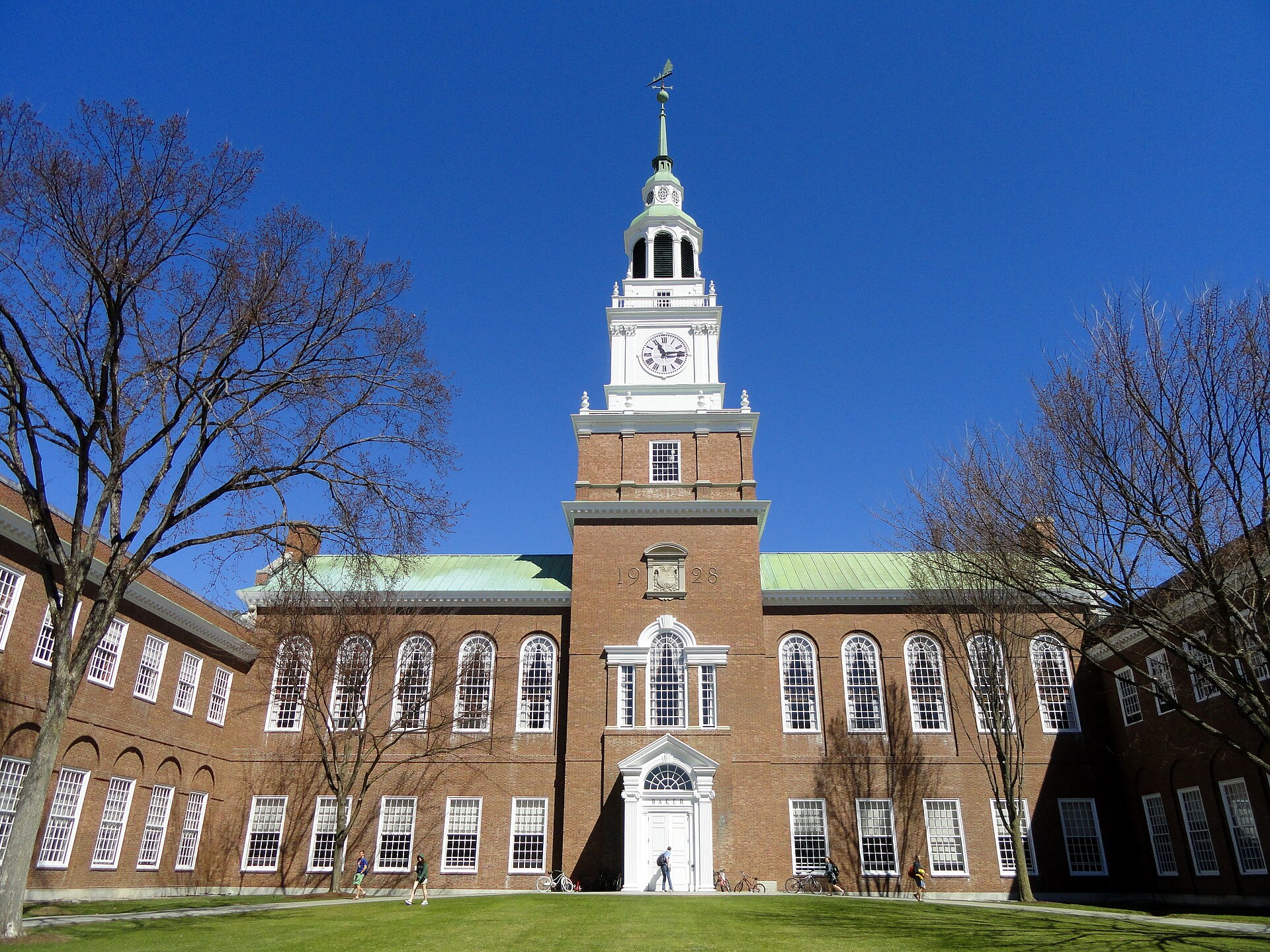
Dartmouth testing policy at a glance: Yes, Dartmouth requires standardized testing, and it was the first Ivy to bring the requirement back, announcing in February 2024 that applicants beginning with the Class of 2029 must test. Students at US high schools must submit the SAT or ACT, with no preference between them, while applicants from schools outside the US may satisfy the requirement through one of five routes, including AP, IB, or A-Level results. Families planning a testing timeline around Dartmouth can schedule a consultation to build a complete testing and application strategy.
Source: Dartmouth Admissions, Testing Policy (admissions.dartmouth.edu/apply/testing-policy).
Does Dartmouth Require the SAT or ACT?
Yes. Dartmouth requires standardized testing of every first-year applicant, with the exact form depending on where a student attends high school. Applicants from US high schools must submit results of either the SAT or the ACT, and Dartmouth states no institutional preference between the two. Results from multiple administrations are automatically superscored: Dartmouth considers the highest result on individual sections of either exam regardless of test date or testing platform, and beginning with the 2025-26 cycle, ACT composite superscores are calculated using only the highest English, Math, and Reading sections. The Science and Writing sections may be submitted but are not included in the superscore.
For applicants attending school outside the United States, Dartmouth offers five ways to satisfy the requirement: the SAT or ACT; results of three different Advanced Placement exams, ideally spread across subject areas with at least one in math or science and one in history, social science, or English; predicted or final International Baccalaureate Diploma Program results on the 1-to-7 scale; at least three British A-Level exams, predicted or final; or final results from an equivalent standardized national exam such as the French Baccalaureate, CBSE, ICSE, KCSE, WASSCE, or CAPE. Two cautions apply to the national exam route: school-based exams do not qualify, and predicted national results do not satisfy the requirement, so students whose finals arrive after February need a different option. Scores may be self-reported, with officials due before enrolling.
How Has Dartmouth’s Testing Policy Changed?
Dartmouth paused its requirement in June 2020, with Dean of Admissions Lee Coffin choosing the word pause deliberately to signal a temporary measure rather than a philosophy. The college then used the optional years as a natural experiment, comparing cycles with and without required scores. On February 5, 2024, President Sian Leah Beilock announced the requirement’s reactivation for the Class of 2029, making Dartmouth the first Ivy League school to reverse course and setting off the sequence that Yale, Brown, and Harvard would follow within ten weeks. The requirement has governed every cycle since, including the current 2026-27 cycle.
The decision rested on faculty research with a memorable finding. Analyses by Dartmouth economists and sociologists, alongside broader Ivy-Plus studies, showed that standardized scores predict success in Dartmouth’s curriculum regardless of a student’s background or family income, and that scores read against local school norms carry real information: a 1400 from a high school whose average is 1000 tells the committee something powerful about a student’s ability to excel. Under the optional policy, many such students withheld scores that would have helped them, leading Dartmouth to conclude it was unintentionally overlooking applicants from less-resourced backgrounds. Testing, the college emphasized, informs decisions rather than dictating them.
| Policy Detail | Dartmouth |
|---|---|
| Requirement status | Standardized testing required for all first-year applicants |
| In effect since | Class of 2029 (announced February 5, 2024; first Ivy to reinstate) |
| US high schools | SAT or ACT, no preference between the tests |
| Non-US high schools | Five routes: SAT or ACT; three AP exams; predicted or final IB; three A-Levels; or final national exam results |
| Superscoring | Automatic for both exams across dates and platforms; ACT composite uses highest English, Math, and Reading only |
| Reporting | Self-reporting allowed with officials due before enrolling; English proficiency exam required for some non-native speakers |
What SAT and ACT Scores Are Competitive at Dartmouth?
Dartmouth reads every score in the context of a student’s school, and its own reinstatement letter stressed that results below the median can still help an applicant from a less-resourced environment. For most families in competitive high schools, though, the practical bar tracks the rest of the Ivy League: recent middle 50 percent ranges for admitted students have run from the high 1400s to around 1560 on the SAT, with ACT composites in the 33 to 35 band. Our working guidance for Ivy-Plus applicants is to treat roughly 1500 to 1530 as a competitive entry point and 1570 or above as positioning above the median admitted student. Dartmouth’s automatic superscoring of both exams makes those targets assemblable across sittings.
How Should You Plan Testing for Dartmouth?
Dartmouth’s Early Decision deadline falls at the start of November and Regular Decision in early January, so early applicants should aim to complete testing by October and regular applicants by December. The automatic superscore across dates and platforms rewards a plan of one spring sitting in junior year plus a fall retake, since only the best sections count and there is no penalty for an uneven administration. ACT students should focus preparation on English, Math, and Reading, the sections that now drive the composite superscore. International students choosing the AP, IB, A-Level, or national exam routes should verify timing carefully, because final national results arriving after February force a switch to another option mid-cycle.
For the picture across every top school, see our full guide to which colleges require the SAT and ACT. From there, Columbia vs Dartmouth: Which Ivy Is the Better Fit?, Yale vs Dartmouth: Admissions, Aid, and Fit Compared, and SAT and ACT Prep Timeline: 9th Through 12th Grade Roadmap for Elite Admissions can help you put testing inside a complete Dartmouth application strategy.
What Does This Policy Mean for Your Application Strategy?
Strategically, Dartmouth’s policy rewards early clarity about which route a student is on. US applicants have one job: build the strongest SAT or ACT superscore the calendar allows. International applicants should choose their route junior year rather than senior fall, since three APs or a full A-Level slate cannot be conjured at the last minute, and the national exam route’s final-results-only rule can quietly disqualify a plan. Dartmouth’s own research argues against strategic withholding everywhere it still exists: scores read in context helped exactly the students who were most tempted to hide them. A number built for Dartmouth also serves the rest of a list on which nearly every peer now requires one.
Frequently Asked Questions About Dartmouth’s Testing Policy
No. Dartmouth reactivated its standardized testing requirement in February 2024, effective with the Class of 2029, and it governs the current 2026-27 cycle. It was the first Ivy League school to bring the requirement back.
Yes, automatically for both. Dartmouth considers the highest individual section results across all administrations regardless of test date or platform, and ACT composite superscores are built from the highest English, Math, and Reading sections.
Applicants from non-US high schools have five routes: the SAT or ACT, three different AP exams, predicted or final IB Diploma results, at least three A-Levels, or final results from a standardized national exam such as the French Baccalaureate or CBSE.
No. Predicted IB and A-Level results are accepted, but the national exam route requires final official results, and school-based exams do not qualify. Students whose finals arrive after February must use a different route.
No. Both may be submitted, but neither is included in Dartmouth’s superscore, which uses only the highest English, Math, and Reading sections, so preparation time is best spent there.
Recent middle 50 percent ranges run from the high 1400s to around 1560, with ACT composites of 33 to 35. We suggest treating roughly 1500 to 1530 as a competitive entry point and 1570 or above as above-median positioning, always read in school context.
Faculty research showed scores predict success at Dartmouth across income levels and that a strong score from a modest school carries powerful contextual information. Under the optional policy, students who would have benefited most were withholding scores, so Dartmouth concluded it was overlooking talent.
Yes. Self-reported scores are considered in the review, and admitted students who enroll must submit official results beforehand. Some non-native English speakers must also add a proficiency exam such as the TOEFL, IELTS, Duolingo, or Cambridge.
Sources: Dartmouth Admissions, College Board SAT Suite, ACT, NCES College Navigator, College Scorecard.
Testing also matters after early decisions: if you are deferred, a stronger winter score is one of the cleanest updates you can send. See our guide to being deferred from Dartmouth.
About Oriel Admissions
Oriel Admissions is a Princeton-based college admissions consulting firm advising families nationwide on elite university admissions strategy. Our strength is a deeply experienced team and a distinctive 360 approach that treats every part of the application – academics, testing, activities, essays, and interviews – as one connected strategy. To discuss your strategy, schedule a consultation.