What Is St Andrews Acceptance Rate for 2025 Entry?
The University of St Andrews admitted approximately 12% of all undergraduate applicants for 2025 entry, based on UCAS data and institutional reports. St Andrews received approximately 21,000 undergraduate applications and admitted roughly 2,500 students. This places St Andrews among the more selective UK universities, though less selective than Oxford (17%), Cambridge (21%), Imperial (14% overall but 6% for Computing), or LSE (9%).
Course-specific admit rates vary by program. Medicine admitted approximately 7% of applicants, the most selective program at St Andrews. International Relations admitted approximately 9-11%. Economics admitted approximately 11-13%. English Literature admitted approximately 13-15%. Mathematics admitted approximately 14-17%. Sciences (Chemistry, Physics, Biology) admitted approximately 16-20%. Lower-demand humanities programs (Classics, Theology, Modern Languages) admitted approximately 22-25%.
US applicants are particularly well-represented at St Andrews. Approximately 18% of St Andrews undergraduates are American, the highest US student percentage of any UK university. The US applicant pool is large and academically strong, and the university maintains specific recruitment relationships with US prep schools and high schools. US applicants with competitive academic profiles often have admit rates somewhat higher than the overall figure for non-Medicine programs.
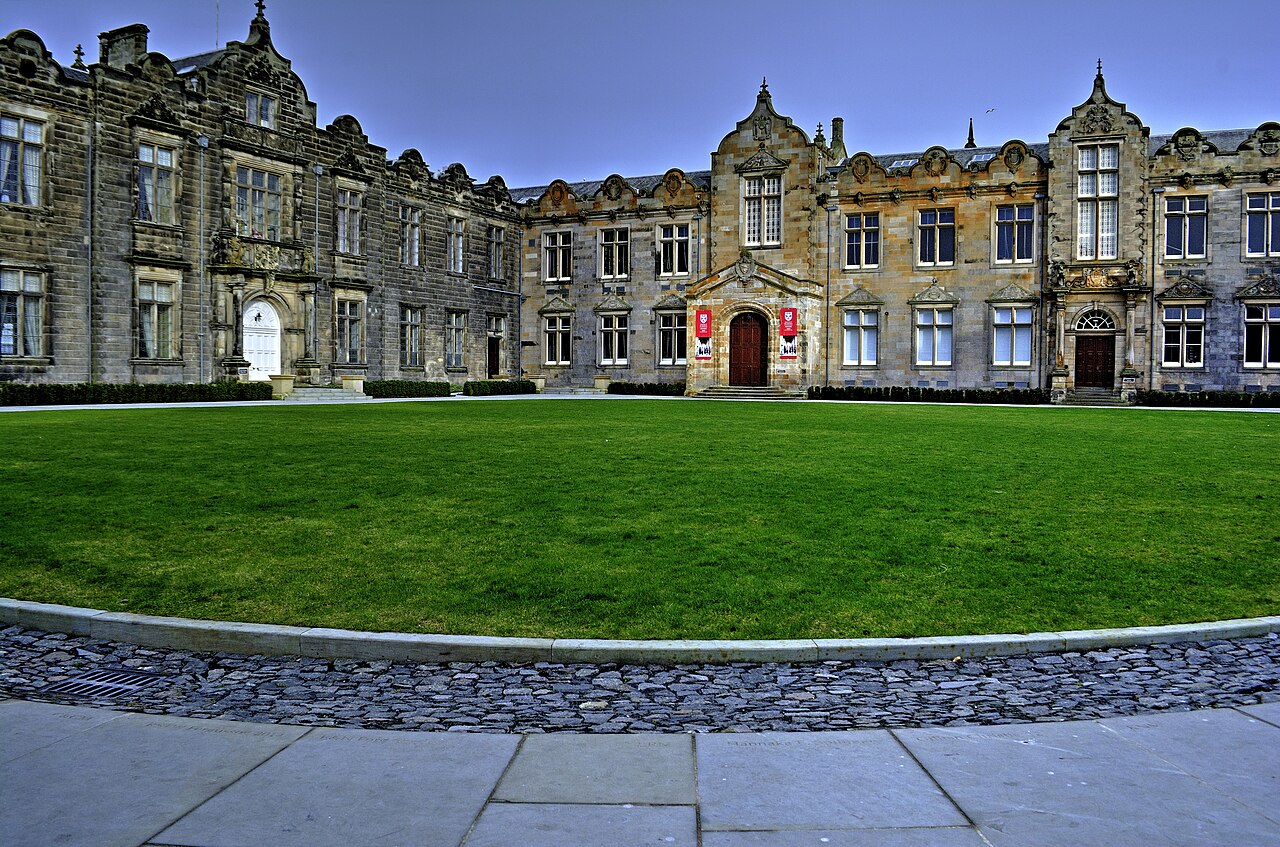
St Andrews is the oldest university in Scotland (founded 1413) and the third-oldest in the English-speaking world after Oxford and Cambridge. The university has gained substantial international visibility through royal connections (Prince William and Catherine Middleton met there in 2001-2002), through consistent rankings in the top 5 UK universities, and through specific cultural attributes that distinguish it from other UK universities. International rankings typically place St Andrews at 80-100 globally per QS World University Rankings, with stronger UK rankings (typically top 5).
How Do Scottish Four-Year Degrees Differ From English Three-Year Programs?
St Andrews follows the Scottish university degree structure, which differs substantially from English universities like Oxford, Cambridge, Imperial, and LSE. Understanding the structural differences is critical for US applicants weighing UK options.
First, Scottish degrees are four years, not three. Most St Andrews undergraduate programs lead to an MA (Master of Arts) or BSc (Bachelor of Science) over four years of study, compared to the three-year BA or BSc at most English universities. The fourth year is integral to the degree, not an optional extension. This makes St Andrews degree timelines comparable to US bachelor degrees, which can simplify graduate school applications and US employer recognition.
Second, the Scottish system allows broader curriculum exploration in the first two years. Students typically take three subjects in their first year and continue with at least two through the second year before specializing in their honours subject (or two-subject joint honours) for years three and four. This flexibility resembles US liberal arts colleges and contrasts with English universities where students commit to a single subject from year one. For US applicants who value curriculum exploration, St Andrews offers substantially more flexibility than Oxford, Cambridge, Imperial, or LSE.
Third, the honours classification system parallels English universities (First-Class, Upper Second, Lower Second, Third), but the four-year structure means honours degrees from St Andrews are sometimes considered equivalent to a US bachelor degree plus an extra year of advanced study. US graduate programs and employers generally recognize the four-year St Andrews MA as equivalent to a US bachelor degree.
Fourth, students can choose between a three-year ordinary degree (rare and not recommended for US applicants) and a four-year honours degree (the standard pathway). All competitive academic, professional, and graduate school pathways require the four-year honours degree. US applicants should plan for and budget for the full four years.
How Do US Applicants Apply to St Andrews Through UCAS?
St Andrews applicants apply through UCAS (the Universities and Colleges Admissions Service), the centralized UK university application system. The process is largely the same as other UK universities, with some St Andrews-specific elements worth noting.
First, applicants apply to a specific course (degree program), not the university broadly. UCAS allows up to five course choices total across all UK universities. St Andrews accepts only one application per applicant; applying to multiple St Andrews courses is not permitted. Joint honours programs (combining two subjects, such as English and History) count as a single course choice.
Second, the UCAS personal statement (4,000 characters, approximately 600 words) must focus on the chosen subject area. Like other UK universities, St Andrews expects 70-80% of the statement to address academic interest, intellectual depth, relevant reading, and aptitude. However, St Andrews tends to be slightly more receptive to extracurricular content than Oxford, Cambridge, Imperial, or LSE, particularly when extracurriculars demonstrate broader cultural engagement, leadership, or artistic depth that fits the university’s liberal arts character. US applicants can include 20-30% extracurricular content if it meaningfully complements subject focus.
Third, predicted grades from the secondary school carry weight. UK applicants have predicted A-level or Scottish Higher grades. US applicants substitute with US transcripts, AP scores, SAT/ACT scores, and counselor predictions. St Andrews expects US applicants to demonstrate competitive academic strength: typically 4+ APs at score 4+ for most courses (5+ APs at score 5 for Medicine and competitive programs), strong SAT scores (1450+ for most courses; 1500+ for Medicine and competitive humanities), and high GPA (3.85+ unweighted for most courses; 3.95+ for Medicine).
Fourth, the UCAS deadline for St Andrews is January 25 for most courses, October 15 for Medicine. This is later than Oxford/Cambridge/Imperial (October 15 universal) but matches LSE for non-Medicine programs. Decisions are typically released between February and April. Applicants reply to firm and insurance choices by early May. For broader timeline context, see our college admissions timeline guide.
Fifth, St Andrews does not require subject-specific admissions tests for most courses. Medicine applicants take the UCAT (University Clinical Aptitude Test). No other St Andrews program requires standardized subject testing beyond UCAS materials.
What Are St Andrews Admission Requirements for US Applicants?
St Andrews publishes course-specific requirements on each program page, but the academic profile for competitive admission follows consistent patterns across program types. US applicants should match their academic profile to the demands of the chosen course.
Medicine (MBChB Bachelor of Medicine and Surgery): GPA 3.95+ unweighted, 5+ APs at score 5 including AP Biology and AP Chemistry essentially required, SAT 1500+ (with 750+ Math and 750+ EBRW), strong UCAT score (typically 2700+ out of 3600). Medicine at St Andrews is a six-year pathway with the first three years at St Andrews (BSc) and the final three years at a partner medical school (typically Dundee). The early UCAS deadline for Medicine is October 15, and the program receives approximately 2,000 applications for around 150 places.
International Relations and Economics: GPA 3.9+ unweighted, 5+ APs at score 5 including AP US History or AP World History plus AP US Government or AP Comparative Government for IR, AP Macroeconomics and AP Microeconomics for Economics, SAT 1480+. Personal statement should demonstrate substantive engagement through specific reading, research, or competitions.
Mathematics, Computer Science, and quantitative programs: GPA 3.9+ unweighted, 5+ APs at score 5 including AP Calculus BC required, AP Statistics or additional STEM APs preferred, SAT 1480+ (with 750+ Math). St Andrews quantitative programs are competitive but less mathematically demanding than LSE Economics or Imperial Mathematics; US applicants with strong but not exceptional math preparation can succeed.
English Literature, History, Classics, Philosophy, Modern Languages: GPA 3.85+ unweighted, 4-5 APs at score 4-5 including subject-relevant APs (AP English Literature, AP World History, AP Latin, AP relevant language). SAT 1450+. The personal statement should demonstrate substantive intellectual engagement with the field through specific texts and arguments.
Sciences (Chemistry, Physics, Biology, Geology), Psychology, Management, and other programs: GPA 3.85+ unweighted, 4+ APs at score 4+ with subject-relevant focus, SAT 1430+. These programs offer the most realistic admit probability for academically strong but not exceptional US applicants.
How Do St Andrews Costs Compare to Top US Universities?
St Andrews international tuition for 2025-26 entry runs approximately £30,000-£37,000 per year ($37,000-$46,000 USD at current exchange rates). Most arts, humanities, and social science programs sit at the lower end (£30,000-£32,000); science programs at the middle (£32,000-£35,000); Medicine at the higher end (£37,000+ for the St Andrews years). St Andrews is substantially less expensive than Imperial ($50,000-$55,000) and meaningfully less than LSE ($36,000-$40,000) for most programs.
St Andrews living costs run approximately £14,000-£18,000 per year ($17,500-$22,500), substantially lower than London ($25,000-$30,000) due to the small-town location. Total annual cost for a US student runs approximately $55,000-$65,000, lower than both LSE ($60,000-$70,000) and Imperial ($75,000-$85,000).
St Andrews degrees are four years (matching US bachelor degrees), so the four-year cost is approximately $220,000-$260,000 total. This compares favorably to four-year US private universities (Harvard, Stanford, Yale, Princeton) at $360,000-$400,000, producing four-year savings of $100,000-$180,000. The savings are smaller than the three-year UK degrees at LSE or Imperial because the duration is the same as US programs, but the per-year cost differential is meaningful.
St Andrews offers limited but more accessible financial aid for international students than Imperial or LSE. The St Andrews Scholarships Office administers approximately £2 million annually in international student support. The most notable awards: St Leonard’s College Scholarships (typically £4,000-£8,000 per year), Wardlaw Scholarships, and various country-specific and subject-specific awards. Approximately 8-12% of international applicants receive some form of merit-based aid. External scholarships (Marshall, Fulbright, Saltire) can fund St Andrews study but require separate competitive application. For broader cost decision context, see our financial aid for upper-middle-class families guide.
How Do St Andrews Course-Specific Admit Rates Compare?
Course-based admissions at St Andrews produces meaningfully different admit rates by program. Course selection significantly affects admit probability for the same applicant profile.
| Course | Approximate Admit Rate | Standard US Profile | Required Tests |
|---|---|---|---|
| MBChB Medicine | ~7% | GPA 3.95+, 5+ APs at 5, SAT 1500+ | UCAT required |
| MA International Relations | ~9-11% | GPA 3.9+, 5+ APs at 5, SAT 1480+ | None |
| MA Economics / Economics joint honours | ~11-13% | GPA 3.9+, 5+ APs at 5, SAT 1480+ | None |
| MA English Literature | ~13-15% | GPA 3.85+, 4-5 APs at 4-5, SAT 1450+ | None |
| MA History | ~14-17% | GPA 3.85+, 4-5 APs at 4-5, SAT 1450+ | None |
| BSc Mathematics | ~14-17% | GPA 3.9+, 5+ APs at 5 (Calc BC), SAT 1480+ | None |
| BSc Computer Science | ~15-18% | GPA 3.9+, 5+ APs at 5, SAT 1480+ | None |
| BSc Chemistry / Physics / Biology | ~16-20% | GPA 3.85+, 4+ APs at 4+, SAT 1430+ | None |
| MA Psychology | ~17-20% | GPA 3.85+, 4+ APs at 4+, SAT 1430+ | None |
| MA Management / Business | ~18-22% | GPA 3.85+, 4+ APs at 4+, SAT 1420+ | None |
| MA Classics / Philosophy / Theology | ~22-25% | GPA 3.8+, 4+ APs at 4+, SAT 1400+ | None |
| MA Modern Languages | ~20-25% | GPA 3.8+, 4+ APs at 4+, SAT 1400+ | None |
Source: University of St Andrews undergraduate admissions data, UCAS application reports, and analysis of recent admissions cycles. Specific rates vary year-to-year based on applicant pool composition.
What Is the American Student Experience at St Andrews?
St Andrews has the largest US student population of any UK university, with approximately 18% of undergraduates holding US passports (per NACAC international education data). This produces a distinctive cultural environment that resembles a US liberal arts college more than a typical UK research university, and US applicants find the social transition substantially easier than at other UK universities.
The town of St Andrews is small (population approximately 17,000 including students), residential, and dominated by the university. Students live in residence halls or university-affiliated accommodation; the campus is integrated with the town rather than separate from it. The combination of small-town setting, residential character, and integrated campus-town environment closely matches affluent US liberal arts colleges (Williams, Amherst, Dartmouth, Hamilton). For US applicants accustomed to that environment, St Andrews offers a familiar transition; for US applicants who want urban environment and large research university scale, LSE or Imperial in London are better fits.
Academic structure also accommodates US students well. The first two years allow students to take courses across multiple subjects (typically three subjects in year one, at least two in year two), which allows US students who are uncertain about their final specialization to explore. This contrasts with Oxford, Cambridge, Imperial, and LSE, where students commit to a single subject from year one. US students who want to explore before specializing can do so at St Andrews; US students who already know their specialization can still benefit from the broader academic exposure.
Social structure is dominated by traditions specific to St Andrews: the academic family system (older students mentor incoming students), the Pier Walk (Sunday tradition), the May Dip (May 1 sunrise tradition), and various academic societies. US students generally find these traditions easy to adopt and report strong social integration. The relatively small size of the university (approximately 10,000 students total) and the residential town environment make social connection substantially easier than at large urban universities.
Career outcomes for US graduates are strong but more dispersed than LSE or Imperial. St Andrews produces strong placement to UK and US finance (with London and Edinburgh recruiting presence), consulting, government and policy roles, academia (top US graduate school placement), and the diplomatic corps. The university’s alumni network in the US is active, particularly among finance and policy professionals on the East Coast. For students intending US graduate or professional school (law, medicine, business, PhD), St Andrews is widely recognized.
Should Affluent US Families Choose St Andrews Over Oxford, Cambridge, or US Liberal Arts Colleges?
The St Andrews decision framework requires comparison against three different alternative paths: other UK universities (Oxford, Cambridge, Imperial, LSE), US liberal arts colleges (Williams, Amherst, Dartmouth), and US research universities (Princeton, Yale, Stanford). The right answer depends on specific applicant priorities.
St Andrews vs Oxford and Cambridge: Oxbridge offers higher global brand prestige, more rigorous tutorial-based pedagogy, and stronger placement to elite UK and US graduate programs. St Andrews offers higher admit probability for similar academic profiles (Oxford 17%, Cambridge 21%, St Andrews 12% but with broader acceptance of non-Medicine programs at 14-25%), greater curriculum flexibility (broader first two years vs. single-subject focus from year one), and more US-friendly cultural environment. Choose Oxford or Cambridge if maximum prestige and intellectual rigor are priorities; choose St Andrews if curriculum flexibility, US-friendly culture, and higher admit probability matter.
St Andrews vs Imperial and LSE: Imperial and LSE offer specialized depth in STEM and social sciences respectively, London location with major-city career networks, and three-year compressed degree timelines (cost savings). St Andrews offers four-year duration matching US bachelor degrees (graduate school timing alignment), broader curriculum across humanities and sciences, lower cost than Imperial, and small-town residential environment. Choose Imperial for STEM depth or LSE for economics/finance/policy depth; choose St Andrews if you want curriculum breadth, residential environment, or lower cost. For LSE comparison, see our LSE strategy guide; for Imperial comparison, see our Imperial strategy guide.
St Andrews vs US liberal arts colleges (Williams, Amherst, Dartmouth, Hamilton): US LACs offer stronger US graduate school placement, established US alumni networks, US faculty connections, and need-based aid that can substantially reduce cost for $200K-$400K income families. St Andrews offers lower published cost (full-pay $220K-$260K vs $360K+ for top US privates), distinctive Scottish university experience, and easier admit probability for academically strong US students. Choose US LACs if you qualify for substantial need-based aid or want US-domestic graduate placement; choose St Andrews if you are full-pay at US schools or want international university experience.
St Andrews vs US research universities (Princeton, Yale, Stanford, Duke): US research universities offer stronger global brand recognition, larger faculty and research operations, broader academic and extracurricular options, and substantial need-based aid. St Andrews offers lower published cost, more focused academic environment, and meaningfully higher admit probability. Choose US research universities for maximum brand recognition or substantial need-based aid; choose St Andrews if full-pay at US schools or seeking international university experience with US-friendly culture.
What Are the Most Common Mistakes US Applicants Make on St Andrews Applications?
Three patterns produce regrettable St Andrews outcomes for US families. Each is preventable with the right preparation.
First, overestimating St Andrews admit difficulty for non-Medicine programs. US applicants who have heard “St Andrews accepts 12%” sometimes assume it functions like a top US university (Brown, Cornell, Dartmouth at 5-6%) and underprepare for the chosen course as if a strong but not exceptional academic profile is sufficient. The fix: recognize that St Andrews course-specific admit rates for academically strong US applicants in non-Medicine programs are often 18-25%, meaningfully more achievable than top US privates, but still require competitive academic profiles.
Second, treating St Andrews like a US application. St Andrews still uses UCAS, requires a subject-focused personal statement, and evaluates applications primarily on academic profile rather than the holistic factors US universities consider (extracurriculars, leadership, demonstrated interest, fit). US applicants who rely on US-style holistic positioning (extensive extracurricular involvement, leadership roles, distinctive personal narratives) without strong academic depth in the chosen subject consistently underperform. The fix: lead with academic depth in the personal statement; treat extracurriculars as supplementary rather than primary.
Third, choosing St Andrews for the wrong reasons. Some US applicants are drawn to St Andrews primarily for the royal connection, the picturesque setting, or the perceived prestige of Scottish university experience, without considering whether the academic program fits their long-term goals. The fix: assess academic fit honestly. St Andrews works well for applicants who want curriculum breadth, small-town residential environment, and four-year degree structure; it works less well for applicants who need urban environment, specific specialized programs (engineering, business, computer science at scale), or substantial need-based aid.
A fourth common mistake: missing the October 15 Medicine deadline. While most St Andrews programs accept UCAS applications until January 25, Medicine applications are due October 15 along with Oxford, Cambridge, Imperial, and other Medicine programs at all UK universities. US applicants planning Medicine often discover this deadline too late to prepare a competitive application including UCAT scores. The fix: treat October 15 as the firm deadline for any Medicine application across UK universities.
Frequently Asked Questions About St Andrews Admissions
Usually not; US applicants educated in English are generally exempt from English-proficiency tests like TOEFL or IELTS, since their schooling satisfies the language requirement. Policies can vary, so confirmation is wise. US students should check St Andrews’ current entry requirements for their situation, but in most cases their English-medium American education means no separate language test is needed, letting them focus on the academic and UCAS components of the application instead.
US students typically need a UK Student visa to study at St Andrews, which requires an offer of admission, proof of funding, and an application through the UK immigration system after receiving a place. The process takes time and has its own requirements. Admitted US students should follow official UK visa guidance and the university’s international student support instructions early, since securing the correct visa is essential before beginning studies in Scotland.
For most subjects the university does not interview applicants, basing decisions on the UCAS application, academic record, and personal statement, though certain programs such as medicine may involve interviews or additional assessments. Requirements vary by course. US applicants should check whether their specific program includes an interview, but for the majority there is no standard interview, so the written application carries the weight of the admission decision.
UCAS applications generally include a single academic reference focused on a student’s suitability for their chosen subject, rather than the multiple, more personal recommendation letters common in US applications. The emphasis is academic and course-specific. US students applying to St Andrews should ensure a teacher or counselor can speak to their academic readiness for the intended field, since the UK reference is more narrowly focused than the holistic letters US colleges typically request.
St Andrews has a notably large American contingent for a UK university, with US students making up a significant share of the international community, drawn by its reputation and the Scottish four-year structure familiar to Americans. The exact proportion shifts year to year. US applicants should know they will find an established American community there, which many find eases the transition, while still experiencing a genuinely Scottish and international university environment.
Yes; the surrounding town is widely known as the ‘home of golf,’ with the historic Old Course and the sport’s deep roots there, and golf is woven into local identity alongside the university. While this is a cultural feature rather than an admissions factor, US applicants drawn to the setting often find the golfing heritage and seaside atmosphere part of the distinctive appeal beyond academics.
Often temporarily; UK graduates, including international students, have generally been eligible for a post-study work route allowing a period of employment in the UK after completing a degree, though immigration rules can change. Longer-term work requires a separate visa. US students hoping to work in the UK afterward should review the current post-study options early, since the ability to stay and work depends on UK immigration policy at the time of graduation rather than the degree alone.
Often yes, especially early on; the Scottish system’s flexible first years typically let students explore multiple subjects before specializing, making it somewhat easier to adjust direction than in more rigid UK programs. Specific changes still require meeting requirements. US students should understand that St Andrews’ four-year Scottish structure offers more early breadth than a typical three-year English degree, giving some room to refine academic focus during the initial years of study.
About Oriel Admissions
Oriel Admissions is a Princeton-based college admissions consulting firm advising families nationwide on elite university admissions strategy. Our team brings deep expertise across every dimension of the application, and our distinctive 360 approach develops strategy, positioning, activities, essays, and interviews as one coherent whole. To discuss your family’s admissions strategy, schedule a consultation.