What are the acceptance rates at Johns Hopkins and WashU for the Class of 2030?
Johns Hopkins admitted 2,795 students for the Class of 2030, distributed as 553 (ED I), 260 (ED II), and 1,982 (RD) (Hub.JHU.edu). Total applications for Class of 2030 have not yet been released. The most recent confirmed acceptance rate is 5.1% for the Class of 2029 (2,525 admits from 49,112 applications) (Johns Hopkins Office of Undergraduate Admissions, March 2026). WashU has not released Class of 2030 acceptance statistics. The most recent confirmed rate is 12% for the Class of 2029, with approximately 3,994 admits from 33,283 applications (source.washu.edu, August 2025). Hopkins is meaningfully more selective than WashU on a raw rate basis, partly reflecting Hopkins' tighter pre-med-focused applicant pool and partly reflecting Hopkins' smaller class size (~1,400 enrolling vs WashU's ~1,800).
| School | Class of 2030 Admit Rate | Applications | Admitted | Yield | Median SAT |
|---|---|---|---|---|---|
| Johns Hopkins | 5.1%* | 49,112* | 2,795 | ~58% | 1500-1560 |
| WashU | 12%* | 33,283* | ~3,994* | ~46% | 1500-1570 |
The yield gap reflects different competitive positioning: Hopkins competes more directly with HYPS and the broader Ivy League for admitted students, losing some cross-admits but maintaining strong yield among committed pre-med applicants; WashU competes with a broader peer set including Hopkins, Duke, Brown, Northwestern, and Vanderbilt, with cross-admit losses spread across multiple peers.
How do the early application options differ at Hopkins and WashU?
Johns Hopkins offers Early Decision I (November 1) and Early Decision II (January 3), both binding. Hopkins ED I admit rate runs approximately 25-30%; Hopkins ED II admit rate runs approximately 12-15%; Hopkins Regular Decision admit rate runs approximately 5% (Johns Hopkins Office of Undergraduate Admissions). Approximately 50-55% of Hopkins' admitted class enters through ED. WashU offers Early Decision I (November 1) and Early Decision II (January 2), both binding. WashU ED I admit rate runs approximately 28-32%; WashU ED II admit rate runs approximately 18-22%; WashU Regular Decision admit rate runs approximately 8-9% (Washington University in St Louis Office of Undergraduate Admissions). Approximately 50% of WashU's admitted class enters through ED. Both schools provide substantial ED selectivity advantages for committed applicants. For pre-med applicants targeting either school, ED I provides the strongest admission chance and demonstrates the commitment level that pre-med advising offices value.
Which school has the stronger pre-med advising and medical school placement?
WashU has the more structured and resource-intensive pre-med advising program at the undergraduate level. The WashU Pre-Health Advising Office maintains dedicated advisors per student, structured timelines for medical school application preparation, and a committee letter process that produces strong outcomes. WashU undergraduates are admitted to medical school at approximately 80-85% rates among committee-supported applicants, well above national averages. WashU's integration with the WashU School of Medicine (top-five medical school nationally) provides clinical exposure, research opportunities, and the WashU School of Medicine Scholars Program (early-assurance pathway with WashU Med). Johns Hopkins also has strong pre-med advising through the Office of Pre-Professional Programs, with medical school admission rates of approximately 75-80% among committee-supported applicants. Hopkins' integration with Johns Hopkins Hospital and Johns Hopkins School of Medicine provides exceptional clinical and research exposure, with the largest hospital research enterprise in the United States. For applicants whose primary goal is medical school admission, both schools provide top-tier outcomes; WashU's advising structure is slightly more supportive, while Hopkins' research and clinical access is slightly deeper.
| Pre-Med Dimension | Johns Hopkins | WashU |
|---|---|---|
| % incoming class pre-health | ~70% (highest among private undergrads) | ~20% (one of highest nationally) |
| Med school applicants/year | ~494 (2023, largest private) | ~400 (2021) |
| Committee-supported med school acceptance rate | ~75-80% | ~80-85% |
| Pre-health advising office | Office of Pre-Professional Programs (PPP) | Pre-Health Advising Office (dedicated advisors per student) |
| Accelerated MD pathway | None (FlexMed available via Mount Sinai partnership) | WashU Med Scholars (~25-30 admits/year, sophomore-year application) |
| Affiliated medical school rank (US News Research) | Top 5 (JHU School of Medicine) | Top 15 (WashU School of Medicine, #11 tie) |
| Affiliated teaching hospital | Johns Hopkins Hospital (largest US research enterprise by NIH funding) | Barnes-Jewish Hospital (free MetroLink connection) |
| Signature pre-med course/seminar | Comprehensive committee letter with university seal | MedPrep seminar + organized ED shadowing at Barnes-Jewish |
What are the BS/MD or accelerated medical school pathways at each?
WashU offers the WashU Med Scholars Program, an early-assurance pathway that selected first-year students can apply to during sophomore year for assured admission to WashU Medical School (subject to maintaining academic standards through senior year). The Scholars Program admits approximately 25-30 students per year. Johns Hopkins does not offer a true BS/MD program but does offer the FlexMed program (early-assurance MD admission for sophomores at Hopkins or other universities) administered by the Icahn School of Medicine at Mount Sinai – though this is a Mount Sinai program rather than a Hopkins program. Hopkins also has the Hopkins Berman Bioethics, Public Health, and Medical Humanities pathways, but these are research-focused rather than accelerated MD pathways. For applicants specifically seeking a structured undergraduate-to-MD pathway, WashU's Med Scholars Program is the more direct option.
How do financial aid policies compare for higher-income families?
Both schools are need-blind for domestic applicants and meet 100% of demonstrated financial need (Johns Hopkins Office of Undergraduate Admissions; Washington University in St Louis Office of Undergraduate Admissions). Hopkins is need-aware for international applicants; WashU is need-blind for international applicants as of the Class of 2025 cohort onward. For families with incomes between $200,000 and $400,000 HHI, expected institutional grant aid typically ranges from $20,000 to $50,000 per year at both schools depending on assets and family size. The substantial difference is in merit aid: WashU offers significant merit-based scholarships through the Annika Rodriguez Scholars, Ervin Scholars, and the named Olin and Danforth scholarships, with the most prestigious awards covering full tuition or full cost-of-attendance. Hopkins offers minimal merit aid (the Bloomberg Scholarships are limited to specific demographic groups). For higher-income families willing to pursue merit consideration, WashU produces lower expected net cost than Hopkins through scholarship competition.
What does campus and student life look like at each?
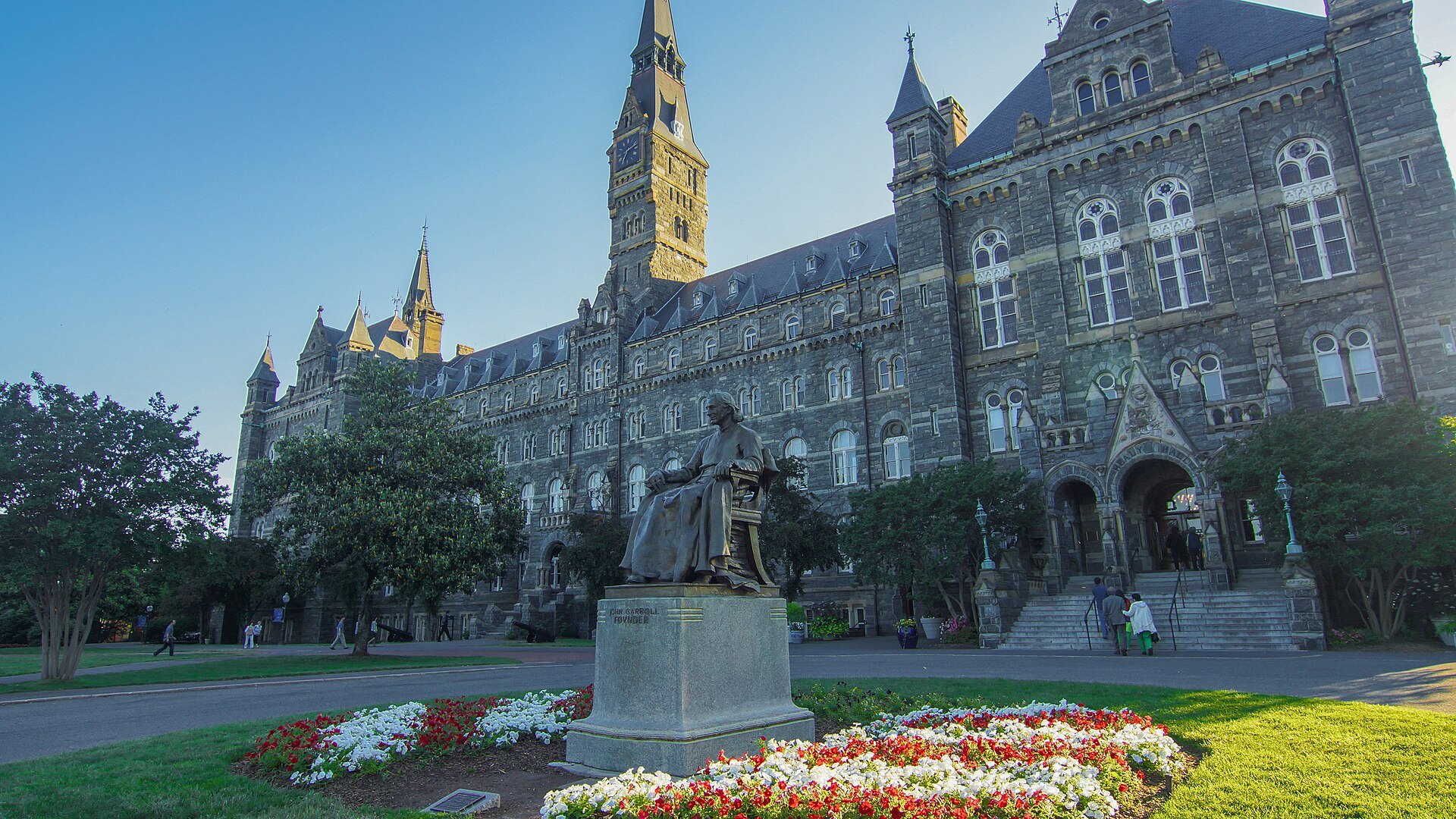
Johns Hopkins' Homewood Campus is in Baltimore, Maryland, in the Charles Village neighborhood approximately three miles north of downtown Baltimore. The campus is contained and residential, with most undergraduates living in or near campus. Hopkins enrolls approximately 5,400 undergraduates, smaller than WashU's 7,800. Hopkins athletic culture is significant through Division I lacrosse (Hopkins Lacrosse is consistently top-ranked nationally) but football and basketball are Division III. Greek life is moderate (~25% of undergraduates). WashU's campus is in St Louis, Missouri, in the Clayton suburb west of downtown St Louis with adjacent Forest Park. The campus is residential with all four years of housing guaranteed, organized through residential colleges and modern housing villages. WashU enrolls approximately 7,800 undergraduates. WashU's athletic culture is Division III through the University Athletic Association (Brandeis, Carnegie Mellon, Case Western, Chicago, Emory, NYU, Rochester) with strong programs in cross country, soccer, basketball, and tennis. Greek life is moderate (~25% of undergraduates).
What other strong programs exist at each school?
Johns Hopkins is known for biomedical engineering (the Whiting School BME program is consistently top-three nationally), public health (the Bloomberg School of Public Health is the world's leading public health school, though graduate-level), international relations (Hopkins SAIS, also graduate-level), and music (Peabody Conservatory). Hopkins Computer Science is strong but not top-tier. WashU is known for biomedical engineering (also top-tier), architecture (Sam Fox School of Design and Visual Arts), business (Olin Business School is top-15), and the Beyond Boundaries flexible curriculum allowing students to design custom interdisciplinary majors. WashU Computer Science is solid but not top-tier. For applicants whose interests extend beyond pre-med to include biomedical engineering, both schools are competitive; for applicants interested in business alongside pre-med, WashU Olin offers a stronger undergraduate business pathway than any Hopkins option.
Where do Hopkins and WashU graduates end up beyond medical school?
Approximately 25-30% of Hopkins graduates and 30-35% of WashU graduates pursue medical school directly or within a few years of graduation. The remaining graduates pursue diverse paths. Hopkins graduates place strongly into investment banking and consulting (~15-20%), technology and engineering (~15%), graduate school in STEM (~10%), and law school and other professional programs (~5-10%). WashU graduates place strongly into consulting (especially through Olin Business School recruiting, ~15-18%), investment banking (~10-12%), technology (~12-15%), graduate school (~8-12%), and law school (~5-7%). For non-pre-med careers, Hopkins offers slightly stronger pipelines into biotech, biomedical engineering industry, and public health-adjacent consulting; WashU offers slightly stronger pipelines into traditional finance and consulting through Olin and into architecture and design through Sam Fox (NACAC career outcomes data).
What admission strategy works at each school for pre-med applicants?
For Johns Hopkins pre-med applicants, the strongest applications combine excellent academic credentials (1500+ SAT, top 5% class rank, AP or IB rigor in biology, chemistry, physics, calculus), substantive research or clinical exposure (laboratory research, hospital volunteering, shadowing experience), and a clearly articulated interest in the Hopkins biomedical environment specifically. ED I provides the strongest admission probability. The Hopkins supplemental essay rewards demonstrated intellectual curiosity in biological or medical questions rather than generic pre-med ambition. For WashU pre-med applicants, the same academic credentials apply, plus alignment with WashU's structured pre-med advising and the WashU Med Scholars Program if applicable. WashU explicitly evaluates intellectual curiosity, leadership, and community impact; ED I produces the strongest selectivity advantage. WashU also weights demonstrated interest more heavily than Hopkins; campus visits, virtual sessions, and substantive engagement with admissions matter at WashU in ways that Hopkins de-emphasizes.
Frequently Asked Questions About Johns Hopkins vs WashU Pre-Med
Johns Hopkins is significantly more selective; its most recent confirmed acceptance rate is 5.1% (Class of 2029) versus WashU's 12% (Class of 2029). Neither has released full Class of 2030 statistics. Hopkins has a tighter pre-med-focused applicant pool and a smaller class size (~1,400 enrolling vs WashU's ~1,800). For pre-med applicants specifically, both schools require similar academic credentials but Hopkins faces denser competition.
WashU has the more structured and resource-intensive pre-med advising program. WashU undergraduates achieve approximately 80-85% medical school admission rates among committee-supported applicants. Hopkins achieves approximately 75-80%. Both are well above national averages. WashU's pre-health advising structure is more supportive; Hopkins' clinical and research access through Johns Hopkins Hospital is slightly deeper.
Yes. The WashU Med Scholars Program is an early-assurance pathway that selected sophomores can apply to for assured admission to WashU Medical School, contingent on maintaining academic standards. Approximately 25-30 students are admitted per year. Hopkins does not offer a comparable BS/MD program at the undergraduate level; pre-med students apply to medical school through the standard timeline.
Both schools have similar published cost-of-attendance (~$87,000 per year for 2025-2026) and similar need-based aid policies. The difference is in merit aid: WashU offers significant merit scholarships (Annika Rodriguez, Ervin, Olin, Danforth) that can substantially reduce net cost for top applicants. Hopkins offers minimal merit aid. For higher-income families pursuing merit consideration, WashU produces lower expected net cost than Hopkins.
Yes if Hopkins or WashU is the top choice. Hopkins ED I admit rate (~25-30%) and WashU ED I admit rate (~28-32%) are dramatically higher than Regular Decision (~5% Hopkins, ~8-9% WashU). Approximately half of each school's admitted class enters through ED. The binding commitment is meaningful, but for committed pre-med applicants the selectivity advantage is substantial.
Johns Hopkins. The Whiting School of Engineering biomedical engineering program is consistently top-three nationally and benefits from direct integration with Johns Hopkins Hospital, the largest hospital research enterprise in the United States by NIH funding. WashU's biomedical engineering program is also top-tier (top-15 nationally) but operates at smaller scale than Hopkins.
Hopkins is known for biomedical engineering, the (graduate) Bloomberg School of Public Health, international relations through Hopkins SAIS (graduate), and the Peabody Conservatory of Music. WashU is known for biomedical engineering, architecture (Sam Fox School), undergraduate business through Olin Business School (top-15 nationally), and the Beyond Boundaries flexible curriculum for interdisciplinary majors.
For finance and consulting, both schools place strongly: Hopkins ~15-20% into investment banking and consulting; WashU ~25-30% (driven by Olin Business School recruiting). For technology, both are competitive but neither is top-tier. For graduate school in STEM, Hopkins has slightly stronger pipelines through its larger research enterprise. For law and government, both are competitive but neither is a primary feeder to top law schools at the volume of Yale, Harvard, or Stanford undergrad.
Sources: Johns Hopkins Office of Undergraduate Admissions; Washington University in St Louis Office of Undergraduate Admissions; Common Data Set; NCES College Navigator; IPEDS; College Board BigFuture; NACAC.
About Oriel Admissions
Oriel Admissions is a Princeton-based college admissions consulting firm advising families nationwide on elite university admissions strategy. Our team brings deep expertise across every dimension of the application, and our distinctive 360 approach develops strategy, positioning, activities, essays, and interviews as one coherent whole. We offer a complimentary 30-minute discovery call to discuss your family’s situation, evaluate fit, and outline next steps. Schedule your discovery call →