UC Berkeley Out-of-State Acceptance Rate: OOS Admissions Strategy for the Class of 2030
By Rona Aydin
TL;DR: UC Berkeley’s out-of-state acceptance rate for the Class of 2029 was 10.0% for fall 2026 – 3,155 admits from 31,707 domestic nonresident applications – compared to the overall 10.5% admission rate and the 12.4% rate for California residents (University of California Office of the President, preliminary data as of June 17, 2026). Out-of-state nonresident tuition for 2024-25 was $46,326 (versus $14,850 for California residents), with total cost of attendance approaching $76,000 per year before financial aid. The University of California system caps systemwide nonresident enrollment at 18%, which structurally limits OOS admissions despite the higher tuition revenue. Berkeley is test-blind (UC system policy), offers no Early Decision or Early Action, and requires a single November 30 application via the UC application portal. California residents make up approximately 68% of admitted students; the EECS program admits under 5% of all applicants. For affluent OOS families navigating Berkeley admissions strategy, schedule a consultation with Oriel Admissions.
What is UC Berkeley’s out-of-state acceptance rate?
UC Berkeley’s out-of-state acceptance rate is approximately 7-8% in recent cycles, materially below the overall acceptance rate of 11.43% for the Class of 2029 (UC Berkeley Office of Planning and Analysis 2024-25). Berkeley does not publish separate OOS acceptance rates in its official communications, but institutional analysis based on the University of California Office of the President’s admissions data consistently shows OOS applicants face roughly two-thirds the admit rate that California residents face. For the Class of 2029, Berkeley admitted 14,502 students from 126,843 applicants; approximately 68% of admits were California residents, leaving roughly 32% split between OOS domestic and international applicants.
The structural reason for the OOS selectivity disadvantage at Berkeley is the University of California Regents’ 2017 cap on systemwide nonresident enrollment at 18%. While the cap applies to total enrolled nonresidents across all UC campuses, it functions in practice as an admissions ceiling at the most selective campuses (Berkeley, UCLA, San Diego). Berkeley has not been able to expand OOS admissions in proportion to its OOS application growth, which produces a structurally lower OOS acceptance rate. Campus-by-campus out-of-state rates across the University of California system are compared in our guide to UC admissions for out-of-state students. For broader context on public flagship OOS admissions across the country, see our guide to out-of-state acceptance rates at public flagships.
What is the cost of attending UC Berkeley as an out-of-state student?
UC Berkeley’s out-of-state tuition for 2024-25 was $46,326 in tuition and fees, compared to $14,850 for California residents – a $31,476 annual differential (UC Berkeley Office of the Registrar published rates). Including room and board (approximately $20,000), books, personal expenses, and travel, total cost of attendance for OOS students approaches $76,000 per year. Over four years, OOS attendance costs approximately $304,000 – approaching private university sticker prices but without comparable institutional financial aid.
UC Berkeley’s financial aid for OOS students is materially less generous than at private peer institutions. Cal Grants (California state aid) are not available to nonresidents; the federal Pell Grant maximum of $7,395 helps lower-income families but does not meaningfully reduce costs for affluent OOS families. Institutional aid is limited, and Berkeley does not commit to meeting 100% of demonstrated need for OOS students the way Harvard, Yale, Stanford, MIT, and most Ivies do. For affluent families weighing Berkeley OOS against private alternatives at similar net cost, the ROI calculation should account for this aid gap. For families weighing the broader value of elite educational pathways, see our ROI analysis on elite education.
| Category | In-State | Out-of-State | Differential |
|---|---|---|---|
| Tuition & Fees (2024-25) | $14,850 | $46,326 | +$31,476 |
| Room & Board | ~$20,000 | ~$20,000 | $0 |
| Total Cost of Attendance | ~$42,000 | ~$76,000 | +$34,000 |
| Four-Year Total | ~$168,000 | ~$304,000 | +$136,000 |
Source: UC Berkeley Office of the Registrar published rates 2024-25; UC Berkeley financial aid published estimates. Total cost of attendance assumes on-campus housing; off-campus costs vary materially in the Berkeley/Oakland rental market.
How does the 18% nonresident enrollment cap affect Berkeley OOS admissions?
In 2017, the University of California Board of Regents bowed to public pressure and capped nonresident enrollment at 18% systemwide. The cap was a response to California residents and legislators concerned that UC had increased OOS enrollment substantially through the 2010s, driven by the higher tuition revenue from nonresidents. The 18% cap covers all UC campuses combined; in practice, it functions as a ceiling at the most selective campuses (Berkeley, UCLA, San Diego) where OOS application volume far exceeds the cap allowance.
For UC Berkeley specifically, this means that as overall application volume has grown (over 126,000 applications for Class of 2029), the OOS acceptance rate has compressed. Berkeley nearly doubled OOS international admission offers from approximately 760 for Fall 2024 to 1,469 for Fall 2025, but this reflects strategic yield management (international students have lower historical yield rates, requiring higher admit volumes) rather than expanded total OOS enrollment. The effective OOS acceptance rate sits at 7-8% and will likely remain there or compress further unless UC Regents revisit the 18% systemwide cap.
What are the application requirements for UC Berkeley?
UC Berkeley uses the UC application (apply.universityofcalifornia.edu), a system-wide application that submits to all UC campuses with a single form. The application requires academic records from grades 9-12 (Berkeley does NOT require transcripts at application; self-reported coursework is used), four Personal Insight Questions (PIQs) of up to 350 words each from a menu of eight options, activities and awards summary, and basic demographic information. There is no separate Berkeley-specific essay beyond the four PIQs.
Berkeley is test-blind, meaning the school will not consider SAT or ACT scores under any circumstances – this is a UC system-wide policy that distinguishes Berkeley from peer public flagships UVA, UNC, Michigan, and UT Austin, all of which require or recommend test scores. Berkeley offers no Early Decision or Early Action; all applicants apply under regular decision, with applications due November 30 and decisions released in late March. The UC application requires letters of recommendation only for honors program supplements; standard freshman admission does not require recommendation letters, which differs from most selective US universities.
How does Berkeley OOS admissions compare to peer public flagships?
UC Berkeley’s 7-8% OOS acceptance rate is among the most selective at any US public university. Among the major OOS-targeted public flagships, the comparison runs roughly: UVA OOS (~16-18%), UNC OOS (~10-12%), Georgia Tech OOS (~15-17%), UT Austin OOS (~10%), Michigan OOS (~18%), and Clemson OOS (~38%). Berkeley sits at the top of this difficulty spectrum, comparable to or slightly more difficult than UT Austin OOS and UNC OOS.
What distinguishes Berkeley OOS from peer public flagship OOS programs is the combination of (1) the systemwide 18% nonresident enrollment cap that structurally compresses OOS admissions, (2) the test-blind policy that removes one differentiator OOS applicants might leverage, and (3) the absence of Early Decision or Early Action that prevents OOS applicants from signaling demonstrated interest. Affluent OOS families pursuing Berkeley should expect the application to feel structurally different from peer flagship OOS applications – more emphasis on the four PIQs, no test scores, no recommendation letters, no demonstrated interest signal.
What major-specific selectivity matters at UC Berkeley?
Berkeley’s admissions are major-specific, meaning admit rates vary substantially by intended major. The Electrical Engineering and Computer Science (EECS) program within the College of Engineering admits under 5% of applicants, making it one of the most selective CS programs in the country alongside CMU School of Computer Science and MIT. The Haas School of Business offers direct freshman admission only through the Management, Entrepreneurship, & Technology (M.E.T.) and Global Management Programs – both extremely competitive; most Haas students apply for admission as sophomores. The College of Letters & Science (which includes the L&S Computer Science major as a separate path) has a higher acceptance rate of approximately 13-15%.
For OOS applicants targeting Berkeley, the major-specific strategy is critical: applying to EECS or M.E.T. as an OOS student means competing against a sub-5% admit rate, while applying to L&S (with intent to declare CS internally after the freshman year) means competing in the 13-15% range. The trade-off is that L&S CS is internally capped and requires GPA performance to declare. Strong OOS CS-focused applicants typically apply to EECS at Berkeley as a reach and a peer like UCLA, UCSD, or Stanford with parallel CS interest as match/safety. For school-list construction principles, see our reach, match, and safety school guide.
How should affluent OOS families approach Berkeley admissions strategy?
For affluent OOS families, Berkeley should be treated as a reach school regardless of academic profile. Even applicants with 3.95+ unweighted GPAs, 12+ rigorous courses (AP, IB, dual enrollment), and substantial extracurricular leadership face the 7-8% OOS admit rate. The four Personal Insight Questions matter materially – they are functionally the application essay, and Berkeley readers spend substantial time on them. Strong PIQ responses use specific, lived examples rather than abstract claims; demonstrate intellectual curiosity and growth; and avoid generic “I want to attend Berkeley because of its diversity” framing.
OOS families should also model the financial commitment carefully. Berkeley OOS at $76,000/year approaches private school sticker prices ($80,000-$90,000 at most Ivies), but without comparable need-based financial aid for upper-income families. For families with household incomes above $250,000, the effective cost difference between Berkeley OOS and Harvard/Yale/Stanford may be minimal once private institutional grants are factored in. Independent advising from Oriel Admissions can help families model Berkeley OOS against private alternatives at the same net cost, optimize the PIQ response strategy, and build a balanced school list that includes Berkeley as one of several reach options.
Frequently Asked Questions About UC Berkeley Out-of-State Admissions
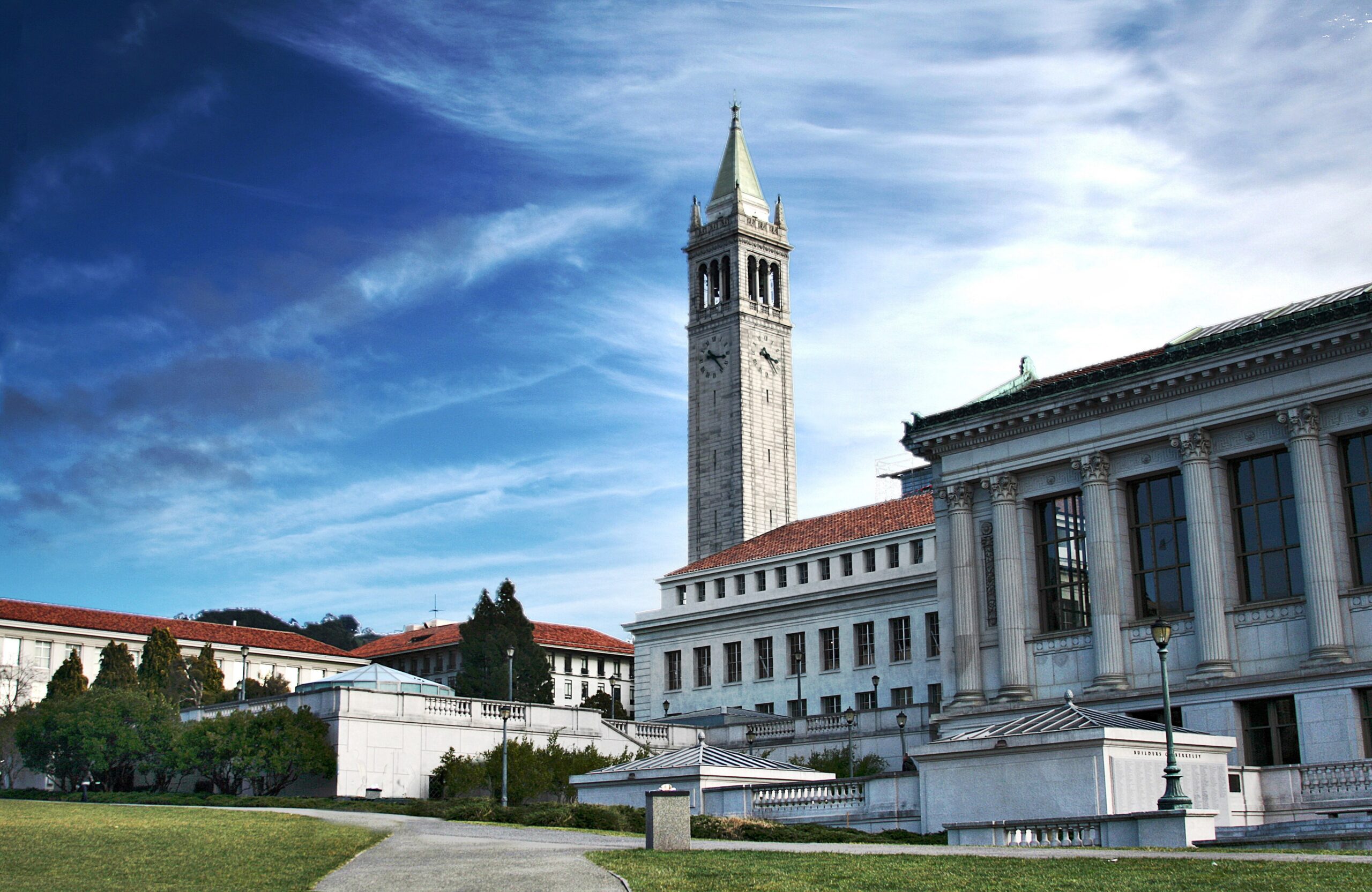
The University of California, Berkeley sits in Berkeley, California, in the East Bay across the bay from San Francisco, with its campus set against the hills overlooking the water. It anchors a lively college town adjacent to a major metropolitan area and the technology and research hub of the Bay Area. The location gives students access to Silicon Valley, San Francisco, and a dense ecosystem of research, internships, and startups.
Berkeley is a flagship public research university renowned for engineering, computer science, business through Haas, the sciences, economics, and a long tradition of academic and social influence. It consistently ranks among the world’s leading universities and produces extensive research and Nobel laureates. Among public flagships it stands out for elite academics across nearly every field, a powerful research enterprise, and a culture of activism and intellectual intensity.
Yes; Berkeley is routinely named among the ‘public Ivies’ and is often regarded as the top public university in the country, with academics comparable to the Ivy League across many disciplines. The term is informal rather than official. Its global reputation, research output, and selectivity place it firmly among the elite universities, so out-of-state families can view it as academically on par with private peers despite its public status.
No; the entire University of California, Berkeley included, practices test-blind admissions, so standardized exam results play no role whatsoever, even when an applicant sends them. Students are judged on grades, coursework rigor, essays, and activities instead. This differs sharply from many other universities, so out-of-state applicants should focus their energy on academics and the UC application rather than test prep when applying to Berkeley.
Berkeley does not use the Common Application; instead, applicants apply through the dedicated UC application, a single system that lets students apply to multiple campuses at once with one set of materials and personal-insight essays. The UC system offers neither early decision nor early action, so every application is due in the fall for the following year. Out-of-state students complete the same UC application as California residents.
Berkeley is large, enrolling roughly 32,000 undergraduates and over 45,000 students total, which places it among the bigger universities nationally. The scale brings extensive course offerings, research opportunities, and activities, but also large introductory classes and competition for spots in popular courses. Out-of-state students who want breadth, world-class research, and a vibrant big-university setting near a major city often find the size a strength.
Very little; the UC system reserves most need-based aid for California residents, and merit scholarships for out-of-state students are limited and highly competitive, so non-resident families should generally budget for the full out-of-state cost. A few competitive scholarships exist. Out-of-state families should research specific awards early but plan to pay close to the full nonresident price, since Berkeley offers minimal aid to students from other states.
Both are top UC flagships and frequent rivals, but they differ in setting and feel: Berkeley is in the East Bay near San Francisco with an intense, research-and-activism-driven culture, while UCLA is in Los Angeles with a larger campus and a culture often seen as more spirited and balanced between academics and athletics. Both are elite and highly selective, so the choice often comes down to location, atmosphere, and program fit rather than prestige.
Sources: UC Berkeley Office of Planning and Analysis; UC Berkeley Office of Undergraduate Admissions; UC Berkeley Office of the Registrar; UC Application; National Center for Education Statistics; UC Office of the President admissions data.
About Oriel Admissions
Oriel Admissions is a Princeton-based college admissions consulting firm advising families nationwide on elite university admissions strategy. Our team brings deep expertise across every dimension of the application, and our distinctive 360 approach develops strategy, positioning, activities, essays, and interviews as one coherent whole. To discuss your family’s admissions strategy, schedule a consultation.