What is Amherst College’s overall acceptance rate, and how selective is it?
Amherst College’s overall acceptance rate for the Class of 2029 was 7.4%, making it the second-most-selective liberal arts college in the United States after Williams. The school admitted 1,175 applicants according to Dean of Admissions Dale Hendricks (The Amherst Student, March 26, 2025). Amherst’s selectivity has tightened in recent cycles as application volume has risen and yield has remained strong. The school is consistently ranked among the top 2-3 liberal arts colleges by U.S. News and shares the gold-standard tier with Williams and Swarthmore.
For peer comparison context, see our Williams vs. Amherst vs. Swarthmore comparison and our broader Liberal Arts Colleges vs. Research Universities analysis.
What is Amherst’s Early Decision acceptance rate, and how does the class composition break down?
Amherst’s Class of 2029 was composed of 43% Early Decision admits, 50% Regular Decision admits, and 7% QuestBridge Match admits, per the official Amherst Class of 2029 Admission and Enrollment Profile. The Class of 2028 ED rate was approximately 29.38%, providing a useful baseline; while Amherst has not formally published the Class of 2029 ED rate as of this writing, the historical pattern suggests the ED rate continues to run roughly four times the overall rate.
The strategic implication for affluent families: Amherst’s ED program offers a meaningful statistical advantage, but the school admits 43% of its class through ED, which means ED applicants compete intensely for a defined fraction of the class rather than for an unlimited share. The ED commitment is binding (admitted students must enroll), and Amherst’s ED yields work because the application demonstrates genuine institutional fit. Strategic ED applications without authentic commitment to Amherst’s intellectual culture often face deferral or denial.
For deeper analysis of ED strategy across elite institutions, see our ED vs. RD Advantage Calculator and our Early Decision vs. Regular Decision analysis.
What does the Amherst student profile look like at the Class of 2029 level?
| Dimension | Amherst Class of 2029 |
|---|---|
| Overall acceptance rate | 7.4% (1,175 admitted) |
| ED share of admitted class | 43% of admitted class |
| RD share of admitted class | 50% of admitted class |
| QuestBridge Match share | 7% of admitted class |
| Total undergraduate enrollment | ~1,970 |
| Setting | Small town (Amherst, Massachusetts; pop. ~38,000) |
| Defining academic feature | Open Curriculum (no distribution requirements) |
| Athletic conference | NESCAC (Division III) |
| 2025-26 comprehensive fee | ~$93,090 ($73,140 tuition + housing/meals/fees) |
| Financial aid policy | No-loan, meets 100% demonstrated need; need-blind for U.S. applicants |
| Five College Consortium access | Cross-registration with Smith, Mount Holyoke, Hampshire, UMass Amherst |
What is Amherst’s Open Curriculum, and how does it shape the undergraduate experience?
Amherst’s Open Curriculum is the school’s most distinctive academic feature and one of only a handful of fully open curricula at top American institutions. Beyond a first-year seminar requirement and the requirements of the chosen major, Amherst students face no general education or distribution requirements. Students design their own academic program with no required courses outside their major. The Open Curriculum is philosophically aligned with Brown University’s better-known Open Curriculum, and the two institutions share a similar institutional commitment to curricular self-direction.
The Open Curriculum produces a campus culture where intellectual exploration is normalized and where students are expected to take responsibility for their own academic development. For applicants, the Open Curriculum carries two implications. First, applications that engage with curricular freedom substantively (in the “Why Amherst” essay, for example) signal genuine fit. Second, students who would benefit from more structure – those who want required exposure to fields outside their interests, those who prefer institutional scaffolding – often find Amherst more challenging to navigate than Williams or Swarthmore, which have more curricular structure.
For comparison with peer LACs that have different curricular philosophies, see our Williams vs. Amherst vs. Swarthmore comparison.
What is the Five College Consortium, and how does it expand the Amherst experience?
The Five College Consortium is Amherst’s most underappreciated institutional advantage. The consortium connects Amherst with Smith College, Mount Holyoke College, Hampshire College, and the University of Massachusetts Amherst, providing free cross-registration in courses, shared library access, free inter-campus busing, and joint academic programs. The combined resource pool is substantial: roughly 5,000 faculty across the five institutions and a course catalog that no single LAC can match.
For Amherst students, the practical value of the Five College system varies by interest. STEM students access UMass Amherst’s substantial science and engineering offerings. Language students access advanced courses across the consortium that Amherst alone could not sustain. Specialized humanities interests (gender studies, translation programs, less-commonly-taught languages) often have stronger offerings at Smith or Mount Holyoke. The consortium also produces a meaningful social experience: students attend events, parties, and intellectual programming across all five campuses, expanding the social pool well beyond Amherst’s 1,970 students.
What is Amherst, Massachusetts like as a setting?
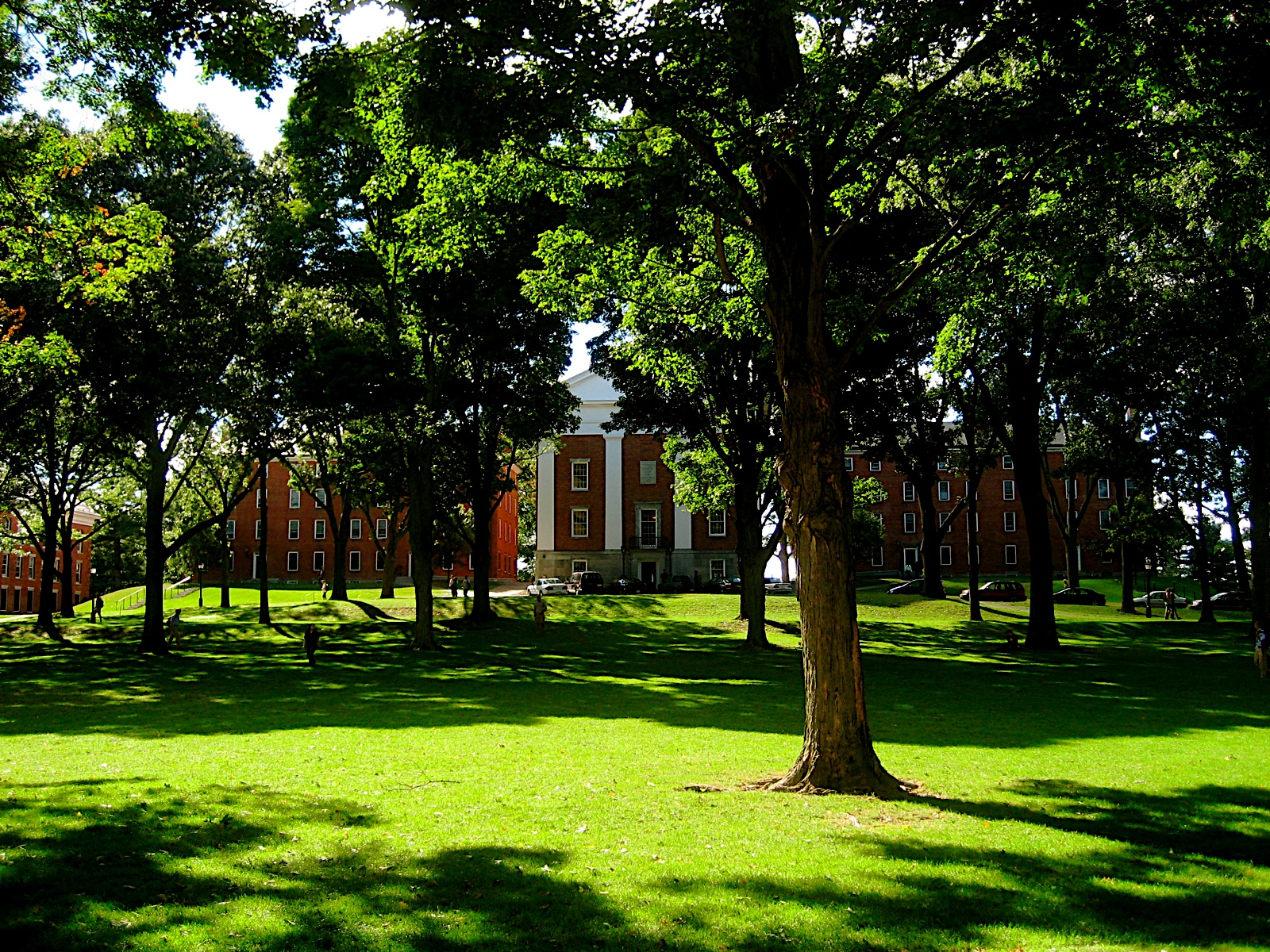
Amherst College is located in the town of Amherst, Massachusetts, in the Pioneer Valley of western Massachusetts. The town is small (population approximately 38,000) but is anchored by the broader Five College Consortium population, giving the area a substantial college-town character that pure rural settings (Williams, for example) do not have. Boston is approximately 90 minutes by car, New York City approximately 3 hours, and the Berkshire mountains are roughly an hour west. The setting is more accessible than Williams’ Berkshire isolation but more rural than Swarthmore’s Philadelphia-suburb position.
Campus life centers on residence halls, athletic teams (Amherst competes in NESCAC Division III, with strong rivalry with Williams in particular), the Mead Art Museum, and Amherst-specific traditions. The academic intensity is genuine; Amherst students typically describe the academic experience as comparable to small Ivy peers but with more institutional warmth and faculty access. Greek life does not exist at Amherst, and social life is more centered on residential communities, athletic teams, and academic peer groups than at peer institutions with stronger Greek systems.
What kind of applicant does Amherst actually admit?
Amherst admissions officers read for three characteristics that recur in admitted classes. First, intellectual self-direction: the Open Curriculum requires students who can design their own academic path, who can articulate clear intellectual interests, and who can sustain academic work without imposed structure. Second, fit with the small-college residential experience: Amherst admits students who can articulate why a small, intensive academic environment with deep faculty access appeals to them, not students who treat Amherst as a generic LAC backup. Third, contribution to the residential community: athletics, music, theater, and other community-building activities matter substantively at Amherst because the small scale of the institution means each student’s contribution to campus life is more visible.
The Amherst supplemental essays are unusually probing for a small college. The “Why Amherst” essay rewards applicants who engage with specific Amherst features: the Open Curriculum, the Five College Consortium, specific faculty research, the senior thesis culture, the residential life. Generic essays that could apply to any LAC fail. Applicants whose academic profiles point toward research universities (intense preprofessional focus, narrow STEM emphasis without intellectual breadth) are often deferred or denied even with strong statistical credentials, because the institutional fit signal is not present. The pattern is documented annually in the National Association for College Admission Counseling State of College Admission report.
How Should Applicants Approach Amherst Supplemental Essays?
Amherst’s supplemental essays carry significant weight in admissions decisions because they differentiate among academically qualified applicants. Strategy varies meaningfully by prompt, word limit, and the specific qualities Amherst looks for. For complete prompts, strategic approach for each prompt, common rejection patterns, and the timeline applicants should follow, see our deep-dive guide: Amherst Supplemental Essays Strategy.
How does Amherst compare on cost and financial aid for high-income families?
Amherst’s 2025-26 comprehensive fee is approximately $93,090, comprising $73,140 in tuition plus $10,410 in housing, $8,850 in meals, and $690 in student activities and fees. Indirect costs (books, personal expenses, travel) typically add several thousand dollars to the total cost of attendance. Amherst meets 100% of demonstrated financial need without loans for admitted students who qualify, and is need-blind for U.S. applicants.
Amherst’s financial aid is among the most generous at any LAC. Families earning under approximately $75,000 with typical assets often pay nothing, and grant aid extends substantially up the income scale. Amherst’s endowment per student is among the highest at any college in the United States, allowing institutional aid generosity that smaller-endowment LACs cannot match. For families above $300,000-$400,000 in income with significant assets, Amherst calculates substantial expected family contributions, but the no-loan grant-based aid structure means the practical net cost is typically lower than the sticker price suggests across most income brackets.
For broader analysis of how affluent families navigate elite school financial aid, see our Harvard financial aid expansion guide and our financial aid strategy for upper-middle-class families.
What are Amherst’s research opportunities and post-graduation outcomes?
Amherst produces unusually strong undergraduate research opportunities for an institution of its size. The Amherst summer research fellowship program funds students to work directly with faculty on original research projects across disciplines, with stipends and housing provided. The student-faculty ratio is roughly 7:1, and undergraduate access to faculty research is closer to graduate-school standard than to typical undergraduate college experience. Senior thesis work is common across departments, and Amherst graduates regularly enter top PhD programs, medical schools, and law schools.
Post-graduation outcomes are exceptional. Amherst consistently ranks among the top liberal arts colleges in PhD production per capita across humanities, social sciences, and natural sciences. The alumni network is small but unusually loyal and well-connected, particularly in academia, finance, journalism, public service, and the arts. For Amherst students drawn to preprofessional pathways (consulting, finance, technology), the network and recruiting access at a small LAC compares favorably with mid-tier Ivies despite the smaller scale. Major employers visit campus for recruiting, and the small-college network advantage is real for graduates entering competitive industries.
What are the most common mistakes applicants make when applying to Amherst?
Five mistakes recur in Amherst applications. First, treating Amherst as a generic top LAC and writing essays that could apply equally to Williams, Swarthmore, or Bowdoin. Amherst’s institutional culture (Open Curriculum, Five College Consortium, small-town setting) is genuinely distinctive, and admissions readers detect generic applications immediately. Second, ignoring the Open Curriculum in supplemental essays. The curricular philosophy is the school’s most distinctive feature, and applications that fail to engage with it signal poor institutional research.
Third, applying without engaging with the Five College Consortium opportunity. The consortium is a meaningful institutional asset that distinguishes Amherst from peer LACs, and applicants who ignore it in their fit essays miss a chance to demonstrate genuine institutional research. Fourth, choosing ED based on perceived statistical advantage rather than authentic fit. Amherst admits 43% of its class through ED, which means ED yields work because applications demonstrate real commitment; strategic ED applications often face deferral or denial. Fifth, underestimating the academic intensity. Amherst admits students who can sustain demanding self-directed intellectual work, and applications that emphasize standard achievement without intellectual depth fail to stand out.
For deeper analysis of why high-stat applicants get rejected at this selectivity tier, see why valedictorians get rejected from elite schools. For testing benchmarks, see our Academic Index Calculator. For broader application strategy, see our college application spike strategy guide.
What is the right academic profile for an Amherst applicant?
Admitted Amherst students typically present GPAs in the 3.9-4.0 unweighted range with rigorous course loads emphasizing AP, IB, or honors-level work. SAT scores cluster in the 1480-1560 range for the middle 50%, with ACT scores in the 33-35 range. Amherst is currently test-optional, but students with scores at or above the median typically benefit from submitting them, particularly for ED applicants seeking to maximize their statistical position.
Beyond raw academic credentials, Amherst selects for intellectual depth in specific areas. Strong applicants typically present a clear academic identity (a specific intellectual interest area, sustained engagement with a field through coursework or independent work, recommendations that articulate genuine intellectual character). The “spike” model of admissions strategy applies particularly well at Amherst: students with deep, distinctive intellectual interests typically outperform students with broader but shallower profiles. For deeper analysis, see our college application spike strategy guide and intended major strategy analysis.
Best for which student?
Best for self-directed students who want curricular freedom plus the intellectual intensity of a top LAC: Amherst’s Open Curriculum and small scale produce a genuinely distinctive academic experience. Best for students who want LAC academics with consortium-scale academic resource access: the Five College Consortium provides cross-registration access that no other top LAC matches. Best for students drawn to a college-town setting with both small-town intimacy and broader regional access: Amherst’s Pioneer Valley location offers more accessibility than Williams without sacrificing the residential intensity of a small college. Amherst is not the right fit for students who prioritize curricular structure (Williams, Swarthmore have more), urban access (Brown, Penn, Columbia), or large-lecture course anonymity.
Frequently Asked Questions About Getting Into Amherst College
Very hard; Amherst’s acceptance rate sits in the high single digits, around 7 to 9 percent, ranking it among the nation’s most selective liberal arts schools. It admits a small class from a deep applicant pool, so nearly all admitted students present top grades and rigorous courses. Strong academics are necessary but not sufficient, since Amherst uses holistic review to choose among many qualified applicants for a limited number of seats.
They are entirely separate schools that happen to share a town. Amherst College is a small, private, highly selective liberal arts college of about 1,900 students, while the University of Massachusetts Amherst is a large public research university enrolling over 30,000. They differ in size, selectivity, mission, and cost. Applicants should be careful not to confuse the two, since admissions standards, programs, and the entire experience are very different.
Amherst is known for its open curriculum with no general-education requirements, its small size and close faculty relationships, and its strength across the liberal arts, particularly in the humanities, social sciences, and sciences. It is also distinctive for the Five College Consortium, which lets students cross-register at neighboring institutions. Among elite liberal arts colleges, Amherst stands out for academic freedom, generous financial aid, and a tight-knit intellectual community.
Yes; Amherst ranks consistently at the very top among the nation’s liberal arts schools, with prestige comparable to the Ivy League for undergraduate education. Its small size, strong outcomes, distinguished faculty, and selective admissions give it national standing. For students who prefer a focused undergraduate experience over a large research university, Amherst is widely regarded as one of the strongest options available.
Admitted students typically present SAT scores roughly in the 1480 to 1560 range or ACT scores around 33 to 35, placing most near the top percentiles nationally. There is no hard cutoff, and Amherst reviews scores in context, but competitive applicants generally land in or above these bands. Confirm the current testing policy on Amherst’s admissions site, since requirements have shifted between test-optional and test-required in recent cycles.
Yes; Amherst superscores, considering your highest section scores across multiple test dates to form the best possible composite. A stronger Math from one sitting combined with stronger Reading and Writing from another counts in your favor, which rewards retaking to improve specific sections. Confirm the current testing requirement on Amherst’s admissions page, but the superscoring practice benefits applicants who sit for the test more than once.
No; Amherst awards only need-based financial aid and gives no merit, athletic, or academic scholarships. All aid is based on demonstrated financial need, and Amherst meets full need for admitted students with notably generous, often loan-free, packages. A high-achieving applicant cannot earn a discount for grades or scores, but families with financial need frequently find Amherst affordable, since its aid program is among the strongest of any liberal arts college.
Amherst suits intellectually curious, self-directed students who will thrive with the freedom of an open curriculum and the intimacy of a small college. Because there are no distribution requirements, the best fits are students excited to design their own academic path and engage closely with faculty and peers. Applicants who want a large university’s scale, big-time athletics, or a pre-set core curriculum may find a different environment more comfortable.
About Oriel Admissions
Oriel Admissions is a Princeton-based college admissions consulting firm advising families nationwide on elite university admissions strategy. Our team brings deep expertise across every dimension of the application, and our distinctive 360 approach develops strategy, positioning, activities, essays, and interviews as one coherent whole. To discuss your family’s admissions strategy, schedule a consultation.