What is Williams College’s overall acceptance rate, and how selective is it?
Williams College’s overall acceptance rate for the Class of 2029 was 8.5%, making Williams meaningfully more selective than several Ivy League peers and the most selective liberal arts college in the United States by overall rate. The school admitted approximately 1,150 students from a pool of approximately 13,500 applicants. Williams’ selectivity has tightened steadily over the past decade as application volume has risen and yield has improved. The school is consistently ranked the #1 liberal arts college by U.S. News and is treated as the gold standard among LACs in admissions consulting.
For comparison context with peer institutions, see our Williams vs. Amherst vs. Swarthmore comparison and our broader Liberal Arts Colleges vs. Research Universities analysis.
What is Williams’ Early Decision acceptance rate, and how does it compare to Regular Decision?
Williams admitted 257 of 964 Early Decision applicants for the Class of 2029, an Early Decision acceptance rate of 26.6% (Williams Record, December 13, 2024). This is roughly three times the overall acceptance rate of 8.5%, reflecting the substantial statistical advantage of binding ED at Williams. The Early Decision pool is meaningfully smaller than the Regular Decision pool, but ED applicants who demonstrate genuine fit with the Williams intellectual culture face a substantially better statistical position than RD applicants of comparable academic profile.
The historical Williams ED trend is informative: the Class of 2027 had an ED rate of 31.20%, the Class of 2028 had an ED rate of 27.04%, and the Class of 2029 had an ED rate of 26.6%. The trajectory reflects rising ED application volume rather than tighter ED admission, and the absolute number of ED admits has remained roughly stable. For families considering ED strategy, Williams is one of the most ED-favorable schools at this selectivity tier.
For deeper analysis of ED strategy across elite institutions, see our ED vs. RD Advantage Calculator and our Early Decision vs. Regular Decision analysis.
What does the Williams student profile look like at the Class of 2029 level?
| Dimension | Williams Class of 2029 |
|---|---|
| Overall acceptance rate | 8.5% |
| Early Decision acceptance rate | 26.6% (257 admitted from 964 applications) |
| Total undergraduate enrollment | ~2,100 |
| Setting | Rural (Williamstown, Berkshire Mountains, Massachusetts) |
| Defining academic feature | Tutorial system (Oxford-style, two students plus one faculty member, weekly) |
| Athletic conference | NESCAC (Division III) |
| 2025-26 comprehensive fee | ~$90,750 ($72,170 tuition + housing/meals/fees) |
| 2026-27 comprehensive fee | ~$95,960 |
| Financial aid policy | No-loan, meets 100% demonstrated need; need-blind for U.S. applicants |
| Test policy | SAT/ACT optional through Class of 2030 admissions cycle |
What is the Williams Tutorial system, and why does it matter for applicants?
The Williams Tutorial system is the school’s most distinctive academic feature and one of the most genuinely unusual undergraduate teaching formats in American higher education. In a tutorial, two students meet weekly for an hour with a single faculty member. Each week, one student presents a substantial original paper while the other prepares a critique; the next week, they switch. The format is adapted directly from the Oxford and Cambridge tutorial tradition, and Williams is the only major U.S. liberal arts college to make tutorials a central institutional feature rather than an occasional honors option.
Approximately half of Williams students participate in at least one tutorial during their undergraduate career. Tutorials are offered across the curriculum (humanities, social sciences, sciences) and produce an intellectual experience that more closely resembles graduate seminar work than traditional college classes. For applicants, the tutorial system carries two implications. First, applications that engage with the tutorial format substantively (in the “Why Williams” essay, for example) signal genuine fit with the school’s institutional identity. Second, students who would not thrive in this format – those who prefer larger lecture courses, who are uncomfortable presenting original work weekly, or who want maximum curricular anonymity – often find Williams less appealing than peer LACs.
For broader context on liberal arts college culture and how Williams compares to peers, see our Williams vs. Amherst vs. Swarthmore comparison.
What is Williamstown like as a setting, and how does it shape the student experience?
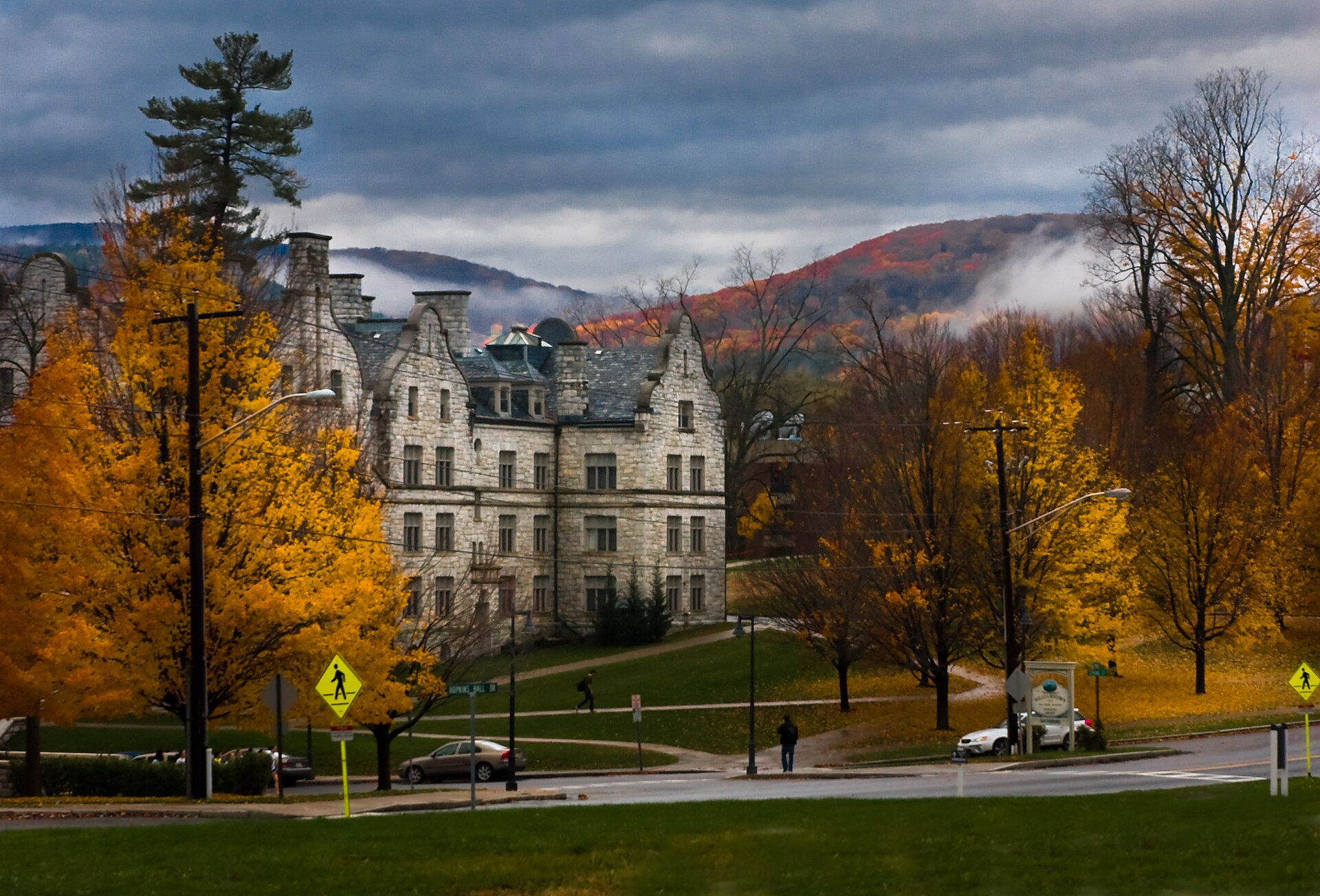
Williams College occupies a contiguous campus in Williamstown, Massachusetts, in the northwestern corner of the state where Massachusetts meets Vermont and New York. The town is small (population roughly 7,500), the Berkshire mountains surround the campus, and the nearest major cities are Boston (about 3 hours by car), Albany (about 45 minutes), and New York City (about 3.5 hours). The setting is genuinely rural and seasonal, with long winters and beautiful falls. Williams maintains the Williams College Museum of Art on campus and is closely affiliated with the Clark Art Institute (a separate world-class museum) just down the road, giving the small town a meaningful cultural footprint.
The isolation is a defining feature of the Williams experience. Students who want regular access to a major city often find Williamstown limiting; students who want a contained, nature-immersed undergraduate experience often find it transformative. Mountain Day, the longstanding tradition where the college president cancels classes for one fall day each year and the entire community hikes Stony Ledge, captures the school’s relationship to its setting. Social life centers on residence halls, athletic teams (Williams competes in NESCAC, Division III, and athletics are central to campus life), the JA (junior advisor) system that pairs first-year entries with upperclass mentors, and the broader small-college residential community.
What kind of applicant does Williams actually admit?
Williams admissions officers read for three characteristics that recur across admitted classes. First, intellectual independence: Williams selects for students who can sustain self-directed academic work, who can hold their own in tutorial-style discussion, and who demonstrate genuine intellectual interests beyond standard high school achievement. Second, fit with the rural setting: Williams admits students who can articulate why a small, isolated, intensive academic environment appeals to them, not students who treat Williams as a generic Ivy backup. Third, contribution to the residential community: athletics, music, theater, and other community-building activities matter substantively at Williams in ways that they do not at larger research universities.
The Williams supplemental essays are unusually probing for a small college. The “Why Williams” essay rewards applicants who engage with specific Williams features: the tutorial system, Mountain Day, the JA system, specific faculty research, off-campus programs like Williams-Mystic or Williams-Oxford. Generic essays that could apply to any LAC fail. Applicants whose academic profiles point toward research universities (intense preprofessional focus, narrow STEM emphasis without breadth) are often deferred or denied even with strong statistical credentials, because the institutional fit signal is not present. The pattern of admissions reader recognition is documented annually in the National Association for College Admission Counseling State of College Admission report.
What are the unique academic programs and off-campus opportunities at Williams?
Beyond the Tutorial system, Williams has built an unusually rich set of off-campus and integrative programs that distinguish the school from peer LACs. Williams-Mystic is a one-semester program in maritime studies based in Mystic, Connecticut, and is widely considered the strongest undergraduate program of its kind in the country. Williams in New York is a one-semester program based in Manhattan focusing on cultural institutions, journalism, and arts policy. Williams-Oxford allows students to spend a year as a member of Exeter College, Oxford, with full tutorial-system immersion at the original source.
The graduate Williams program in art history (the Williams College Graduate Program in the History of Art) is one of the most respected pre-doctoral programs in the country and gives undergraduates studying art history exceptional access to graduate-level mentorship. The Center for Development Economics, while a graduate program, similarly enriches the undergraduate economics experience for serious students. The Williams winter study term (a four-week January term where students take a single intensive course, often experimental or off-campus) is another distinctive feature that has no exact parallel at most peer institutions.
For students considering whether the LAC pathway is the right fit overall, see our Liberal Arts Colleges vs. Research Universities analysis.
How does Williams compare on cost and financial aid for high-income families?
Williams’ 2025-26 comprehensive fee is approximately $90,750, comprising $72,170 in tuition plus $9,250 in housing, $8,990 in meals, and approximately $340 in activities and residential house fees. The 2026-27 comprehensive fee will rise to approximately $95,960, reflecting a roughly 5.7% increase. Indirect costs (books, personal expenses, travel) typically add several thousand dollars to the total cost of attendance.
Williams meets 100% of demonstrated financial need without loans for admitted students who qualify, and is need-blind for U.S. applicants. The school’s financial aid is generous by LAC standards: families earning under approximately $75,000 with typical assets often pay nothing, and grant aid extends substantially up the income scale. For families above $300,000-$400,000 in income with significant assets, Williams generally calculates substantial expected family contributions, but the no-loan policy and grant-based aid structure mean the practical net cost is typically lower than the sticker price suggests for families across most income brackets.
For broader analysis of how affluent families navigate elite school financial aid, see our Harvard financial aid expansion guide and our financial aid strategy for upper-middle-class families.
What are Williams’ research opportunities and post-graduation outcomes?
Williams produces unusually strong undergraduate research opportunities for an institution of its size. The Williams summer research fellowship structure funds students to work directly with faculty on original research projects across disciplines, with stipends and housing provided. The Williams student-faculty ratio is roughly 6:1, and undergraduate access to faculty research is closer to graduate-school standard than to typical undergraduate college experience. Senior thesis work is normalized across departments, and the percentage of Williams students who complete senior theses is among the highest at any liberal arts college.
Post-graduation outcomes are exceptional. Williams consistently ranks among the top liberal arts colleges in PhD production per capita across humanities, social sciences, and natural sciences. Williams graduates are heavily represented in top medical schools, law schools, and PhD programs, often at higher per-capita rates than peers at much larger research universities. The Williams alumni network is small but unusually loyal and well-connected, particularly in academia, finance, journalism, and the arts. For Williams students drawn to preprofessional pathways (consulting, finance, technology), the network and recruiting access at a small LAC compares favorably with mid-tier Ivies despite the smaller scale.
For families weighing whether the LAC pathway produces comparable outcomes to research universities, see our Liberal Arts Colleges vs. Research Universities analysis. For broader analysis of the value of elite undergraduate education for affluent families, see our Ivy League cost and financial aid analysis.
Best for which student?
Best for intellectually independent students who want graduate-school-level academic intensity in an undergraduate setting: Williams’ tutorial system and senior thesis culture are unmatched at peer LACs. Best for students drawn to rural, nature-immersed campus life: Williams’ Berkshire setting, Mountain Day tradition, and small-town community produce a residential experience that more urban LACs cannot replicate. Best for students seeking the highest statistical Early Decision advantage at a top LAC: Williams’ 26.6% ED rate for the Class of 2029 is among the most ED-favorable rates at any school of comparable selectivity. Williams is not the right fit for students who prioritize urban access, large-lecture course anonymity, or a less academically intense undergraduate experience.
What are the most common mistakes applicants make when applying to Williams?
Five mistakes recur in Williams applications. First, treating Williams as a generic top LAC and writing essays that could apply equally to Amherst, Swarthmore, or Bowdoin. Williams’ institutional culture (rural, intensive, tutorial-driven) is genuinely different from peers, and admissions readers detect generic applications immediately. Second, ignoring the tutorial system in supplemental essays. The tutorial format is the school’s most distinctive feature, and applications that fail to engage with it signal poor institutional research.
Third, applying without fit for the rural setting. Applicants who emphasize urban interests, city-based career pathways, or proximity to major metros often signal poor fit with Williamstown. Fourth, choosing ED based on perceived statistical advantage rather than authentic fit. The 26.6% ED rate is meaningful, but ED yields work because applications demonstrate real commitment; strategic ED applications often face deferral or denial. Fifth, underestimating the academic intensity. Williams admits students who can sustain demanding intellectual work, and applications that emphasize standard achievement without intellectual depth fail to stand out.
For deeper analysis of why high-stat applicants get rejected at this selectivity tier, see why valedictorians get rejected from elite schools. For testing benchmarks, see our Academic Index Calculator. For broader application strategy, see our college application spike strategy guide.
What is the right academic profile for a Williams applicant?
Admitted Williams students typically present GPAs in the 3.9-4.0 unweighted range, with rigorous course loads emphasizing AP, IB, or honors-level work across disciplines. SAT scores for the Class of 2029 cluster in the 1480-1560 range for the middle 50%, with ACT scores in the 33-35 range. Williams remains test-optional through the Class of 2030 cycle, but students with scores at or above the median typically benefit from submitting them, particularly for ED applicants seeking to maximize their statistical position.
Beyond raw academic credentials, Williams selects for intellectual depth in specific areas. Strong applicants typically present a clear academic identity (a specific intellectual interest area, sustained engagement with a field through coursework or independent work, recommendations that articulate genuine intellectual character). The “spike” model of admissions strategy applies particularly well at Williams: students with deep, distinctive intellectual interests typically outperform students with broader but shallower profiles. For deeper analysis of academic profile strategy, see our college application spike strategy guide and intended major strategy analysis.
How Should Applicants Approach Williams Supplemental Essays?
Williams’s supplemental essays carry significant weight in admissions decisions because they differentiate among academically qualified applicants. Strategy varies meaningfully by prompt, word limit, and the specific qualities Williams looks for. For complete prompts, strategic approach for each prompt, common rejection patterns, and the timeline applicants should follow, see our deep-dive guide: Williams Supplemental Essays Strategy.
Frequently Asked Questions About Getting Into Williams College
Williams sits in Williamstown, Massachusetts, a small town in the Berkshire Mountains of the state’s rural northwest corner. The setting is remote and scenic, surrounded by hills and hiking trails, roughly three hours from both Boston and New York City. The isolation is intentional to the experience: a tight, residential community where campus life and the outdoors dominate, rather than a city-adjacent campus.
No; they are entirely different schools. Williams College is a small private liberal arts college in Williamstown, Massachusetts. William and Mary is a public research university in Williamsburg, Virginia. The similar names cause frequent confusion, but they differ in location, size, type, and history. This page concerns Williams College, the Massachusetts liberal arts college, not the Virginia university.
Very hard; Williams’s acceptance rate sits in the high single digits, around 8 to 9 percent, ranking it among the most selective liberal arts colleges in the country. It admits a small class from a deep applicant pool, so nearly all admitted students present top grades and rigorous courses. Strong academics are the baseline, with holistic review choosing among many qualified applicants for limited seats.
Williams is known for being one of the very top liberal arts colleges in the US, frequently ranked number one, and for its distinctive Oxford-style tutorials, strength in art history, and the Williams-Exeter program at Oxford. Its small size, rural Berkshires setting, and strong outdoor culture shape a close community. Among elite small colleges it stands out for academic prestige and exceptional graduate-school and career outcomes.
Yes; Williams is consistently counted among the ‘Little Ivies,’ an informal cluster of highly selective Northeastern liberal arts colleges, and it often tops national liberal arts rankings outright. The label is unofficial and grants no formal membership, but it reflects Williams’s Ivy-level selectivity and reputation. It is also a founding member of the NESCAC athletic conference alongside peers like Amherst and Swarthmore.
Williams has used a test-optional policy in recent cycles, letting applicants choose whether to submit SAT or ACT scores without penalty for withholding them, and for those who do submit, it considers the best section scores across test dates. Testing policies among selective colleges shift often, so confirm the current requirement on Williams’s admissions site, but submitting strong scores can still help under a test-optional framework.
Williams competes in NCAA Division III as a founding member of the NESCAC conference, so it offers no athletic scholarships and emphasizes the academic-first balance typical of elite small colleges. Despite Division III status, Williams has one of the strongest overall athletic programs among liberal arts colleges, winning numerous national team titles. Recruited athletes still meet the college’s rigorous academic admissions standards.
No; like most elite liberal arts colleges, Williams awards only need-based financial aid and gives no merit, athletic, or academic scholarships. All aid follows demonstrated financial need, and Williams meets full need with generous, often loan-free packages, including its longstanding commitment to affordability. High stats alone earn no discount, but families with financial need frequently find Williams far more affordable than its sticker price.
About Oriel Admissions
Oriel Admissions is a Princeton-based college admissions consulting firm advising families nationwide on elite university admissions strategy. Our team brings deep expertise across every dimension of the application, and our distinctive 360 approach develops strategy, positioning, activities, essays, and interviews as one coherent whole. To discuss your family’s admissions strategy, schedule a consultation.