Brooklyn’s Top Private Schools and College Admissions: What Families at Poly Prep, Packer Collegiate, Saint Ann’s, and Brooklyn Friends Need to Know
By Rona Aydin
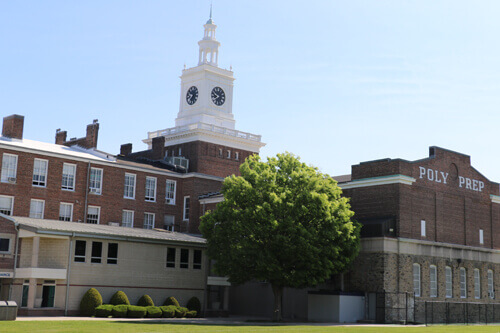
What does Brooklyn’s elite private school landscape actually look like?
| School | Location | Co-ed/Single-sex | Enrollment | Tuition (2025-26) | Notable Strength |
|---|---|---|---|---|---|
| Poly Prep Country Day | Dyker Heights | Co-ed | ~992 PK-12 | ~$58,000 | 1854 founding, 13 sports, scholar-athlete pipeline, NYSAIS championships |
| Packer Collegiate Institute | Brooklyn Heights | Co-ed | ~1,170 PK-12 | ~$57,000 | 17 sports, balanced co-ed environment, 16 avg class size, mass timber expansion 2025 |
| Saint Ann’s School | Brooklyn Heights | Co-ed | ~1,100 PK-12 | ~$60,000 | No-grades policy through middle school, strongest LAC pipeline in NYC (30% T15 LAC) |
| Brooklyn Friends School | Downtown Brooklyn | Co-ed | ~700 PK-12 | ~$54,000 | Quaker tradition, smaller scale, values-driven curriculum |
| Berkeley Carroll School | Park Slope | Co-ed | ~990 PK-12 | ~$56,000 | Park Slope location, broad curriculum |
Each Brooklyn private has a distinctive admissions-office identity that admissions officers at Princeton, Penn, Yale, Cornell, Columbia, and other top-30 universities recognize directly – a pattern of school-specific recognition documented annually in the National Association for College Admission Counseling State of College Admission report. The strategic question for families is rarely about absolute matriculation rates but about cultural fit, geographic considerations, and pedagogical philosophy.
Why does Saint Ann’s no-grades policy matter for college admissions?
Saint Ann’s School in Brooklyn Heights is the only major NYC private school that does not assign letter grades through middle school, instead providing detailed narrative evaluations to families and students. The school transitions to letter grades in the upper school but retains a more narrative-rich evaluation tradition than peer institutions. For college admissions, this creates a distinctive applicant profile – Saint Ann’s students apply with letter grades from high school but with documented elementary and middle school experiences emphasizing intellectual development over numerical performance.
The school produces the strongest top liberal arts college pipeline in NYC, with approximately 30% of graduates matriculating at T15 LACs (Williams, Amherst, Swarthmore, Pomona, Bowdoin, Wesleyan, Carleton, Middlebury, Vassar). Class of 2025 placements include Princeton (3), Stanford (1), Northwestern (4), with strong representation at Brown, Wesleyan, Columbia, and Bard. The strategic implication for families: Saint Ann’s is the strongest NYC private school choice for students targeting elite liberal arts colleges, with admissions officers at top LACs recognizing the school’s distinctive curriculum and student profile directly.
How does Poly Prep’s scholar-athlete identity differentiate it from peers?
Poly Prep Country Day School (founded 1854, originally part of the Brooklyn Collegiate and Polytechnic Institute that became NYU Tandon School of Engineering) maintains the strongest scholar-athlete identity among NYC privates. The school’s Dyker Heights campus features extensive athletic facilities, with 13 varsity sports producing consistent NYSAIS championship results across baseball, basketball, football, and other programs. The school is part of the Ivy Preparatory School League and competes against Manhattan and suburban privates regularly.
For college admissions, Poly Prep’s scholar-athlete identity matters substantively. Recruited athletes targeting Ivy+ programs benefit from the school’s documented athletic infrastructure and coaching relationships. Non-athlete students compete in the school’s strong academic programs without the athletic emphasis dominating their experience. Poly Prep places approximately 20-30% of graduates at Ivy+ universities annually. The strategic implication for families: Poly Prep fits academically strong students who value athletic engagement (whether recreational or recruited) within their high school experience, while families seeking a primarily academic environment may find Saint Ann’s or Packer better fits.
What is Packer Collegiate’s strategic position in Brooklyn Heights?
Packer Collegiate Institute in Brooklyn Heights is one of the largest Brooklyn private schools, with approximately 1,170 students PK-12 across an expanding campus that completed a mass timber Garden House addition in 2025. The school maintains 17 varsity sports and 35 extracurricular programs, with a 16-student average class size that creates intimate learning environments at meaningful scale. Packer’s Brooklyn Heights location creates accessible commutes for Manhattan-adjacent families and Brooklyn families across the borough.
For college admissions, Packer produces consistent matriculation outcomes at top-30 universities, with 20-30% of graduates at Ivy+ schools and strong representation at Cornell, NYU, Columbia, Penn, and Brown. The school’s balanced co-ed environment and broad curriculum serve diverse academic profiles – intellectual seriousness without the explicit progressive identity of Saint Ann’s or the athletic emphasis of Poly Prep. The strategic implication for families: Packer fits students who would benefit from a substantial school size with strong academics, athletics, and arts without dominant institutional identity in any single direction.
How does Brooklyn Friends’ Quaker tradition affect college admissions?
Brooklyn Friends School in Downtown Brooklyn is one of the country’s oldest Quaker schools (founded 1867), with a values-driven curriculum emphasizing service, social responsibility, and community engagement. The school maintains a smaller scale (~700 students PK-12) than peers, with admissions officers recognizing Brooklyn Friends as a values-distinctive Quaker school within the broader Friends school network (Sidwell Friends in DC, Friends Seminary in Manhattan, Germantown Friends in Philadelphia).
For college admissions, Brooklyn Friends produces competitive matriculation outcomes at top-30 universities with particular strength at Quaker-affiliated and progressive institutions (Haverford, Swarthmore, Earlham, Guilford, Wesleyan). The school’s smaller size means top-decile students gain unusual visibility within the college office, and the values-driven curriculum produces strong applicants for service-focused universities. The strategic implication for families: Brooklyn Friends fits students who genuinely connect with Quaker values and service-oriented learning, with strong outcomes at progressive and values-aligned universities. Students without that values fit may find peer Brooklyn privates better cultural matches.
How do Brooklyn privates compare to Manhattan privates strategically?
The strategic comparison between Brooklyn and Manhattan privates favors each region on different dimensions. Manhattan privates (Trinity, Brearley, Spence, Collegiate, Dalton, Horace Mann, Riverdale) produce higher absolute Ivy+ matriculation rates (~35-42% vs Brooklyn’s ~20-30%), stronger institutional admissions-office relationships at top-15 universities, and stronger brand recognition in the broader prep school landscape. Manhattan tuition typically runs $66,000-$69,000.
Brooklyn privates offer substantively lower tuition ($50,000-$60,000), larger campuses with better athletic and outdoor facilities, more intimate community feel, and cultural identities that often fit specific student profiles better than Manhattan flagship homogeneity. For families with daughters seeking strong academics without Manhattan UES intensity, Saint Ann’s or Packer often fit better than Spence or Brearley. For scholar-athletes, Poly Prep’s facilities exceed Manhattan options. For values-driven families, Brooklyn Friends offers what Manhattan’s secular privates cannot. For school-by-school deeper analysis, see our Manhattan UES/UWS deep dive and Trinity/Riverdale/Chapin guide.
What test scores should Brooklyn private school applicants target?
| School Tier Target | Competitive Floor | Strong Likely Admit |
|---|---|---|
| HYPSM (Princeton, Yale, Harvard, Stanford, MIT) | 1530 SAT / 34 ACT / 3.95 GPA | 1560+ / 35-36 / 4.00 + spike |
| Other Ivies + Top 15 (Penn, Cornell, Duke, JHU, Columbia) | 1500 SAT / 33 ACT / 3.90 GPA | 1530+ / 34-35 / 3.95+ |
| Top T15 LACs (Williams, Amherst, Swarthmore, Pomona, Bowdoin) | 1480 SAT / 33 ACT / 3.90 GPA | 1520+ / 34-35 / 3.95+ + distinctive intellectual profile |
| Top 16-30 (NYU, Vanderbilt, WashU, Emory, Michigan) | 1450 SAT / 32 ACT / 3.85 GPA | 1500+ / 33-34 / 3.90+ |
For benchmarking, see our Ivy League Academic Index calculator.
What are the most common Brooklyn private school application mistakes?
Five mistakes recur. First, treating Cornell, NYU, and Columbia as automatic safeties because of geographic proximity. Second, generic essays that recycle prose any Brooklyn private school student could have written. Third, under-leveraging the school’s distinctive institutional advantage – Saint Ann’s narrative tradition, Poly Prep’s athletic infrastructure, Packer’s balanced co-ed environment, Brooklyn Friends’ Quaker values. Fourth, manufactured spikes invented in summer before senior year. Fifth, deferring outside admissions consulting until junior year when meaningful spike development requires sophomore-year start.
For deeper analysis, see why valedictorians get rejected from Ivies, our Early Decision strategy guide, our summer planning guide for rising juniors, and our best summer programs for NYC and NJ students. For school-specific Ivy guidance, see our HTGI cluster: Princeton, Yale, Stanford, Cornell, Columbia.
Frequently Asked Questions About Brooklyn Private School College Admissions
Often yes; many universities recompute GPA on their own unweighted scale so applicants from different schools can be compared fairly, and for schools using narrative evaluations rather than grades, officers read the qualitative record in context. Rigor and performance still matter most. Families should ensure a student takes demanding courses and performs strongly, since colleges interpret each transcript through the lens of the school’s profile rather than one comparable number.
Not through a formal quota; colleges read each applicant in context but do not set a strict cap pitting classmates against one another. A strong school sending many qualified applicants does create a naturally competitive pool, however. Students should focus on a distinctive, authentic profile rather than local rivalries, since what distinguishes an applicant is an individual story and strengths, not edging out peers from the same well-regarded school.
Significantly; each school sends colleges a profile describing its curriculum, grading or evaluation system, and outcomes, which officers use to interpret a transcript in context. A rigorous school’s profile sets high expectations. Families should ensure a student takes full advantage of the demanding courses available, since colleges read achievement through the lens of that profile, and a strong school’s reputation raises the bar for what is expected of its applicants.
It depends on the college; some track engagement such as visits, emails, and interviews, while many of the most selective schools state they do not. Genuine engagement still helps a student write more specific essays. Families should check each target school’s policy and, where interest is tracked, ensure the student engages authentically, since well-researched, specific applications tend to be stronger regardless of whether a college formally measures demonstrated interest.
It varies and is shifting; some colleges still weigh a family connection as one minor factor, while others have eliminated legacy preferences entirely as policies change. It is never decisive on its own. Applicants with a legacy tie should treat it as a small potential consideration rather than a substitute for a strong application, and confirm each college’s current stance, since the weight given to legacy keeps evolving across selective institutions nationwide.
Generally robust; established private schools typically offer dedicated college counseling with low student-to-counselor ratios, personalized guidance, and strong relationships with admissions offices, though quality varies by school. Families should ask about counseling structure, caseloads, and outcomes when evaluating a school, since strong counseling is a meaningful part of a private school’s value, and a counselor who knows a student well can advocate effectively and guide a focused strategy.
It depends on the family and student; private schools offer rigor, counseling, and resources, but admission to top colleges depends on the individual applicant, not the school name, and strong students succeed from many settings. The tuition buys support, not a guarantee. Families should weigh the full value, including fit and environment, rather than expecting admissions results alone, since colleges evaluate students in context and genuine achievement matters more than the school’s price.
Many apply to roughly eight to twelve, balancing reach, target, and likely schools, though the right number depends on goals and finances. Quality and fit matter more than sheer quantity. Students should build a thoughtful, balanced list anchored by genuine interest and affordability rather than applying everywhere, since a well-constructed range across selectivity levels offers both strong options and security, while an excessively long list dilutes the care each application receives.
About Oriel Admissions
Oriel Admissions is a Princeton-based college admissions consulting firm advising families nationwide on elite university admissions strategy. Our team includes former admissions officers from Harvard, Princeton, and Columbia. To discuss your family’s admissions strategy, schedule a consultation.